CompTIA Network+ practice test — with hands-on labs, not just flashcards
Most CompTIA Network+ prep stops at multiple-choice questions. CrushCert adds hands-on labs built like the exam’s PBQs — the drag-and-drop and troubleshooting questions most people fail on — alongside 220+ adaptive practice questions and a full timed mock exam. Call it Network+ or Network Plus — everything for the exam is here, in one place.
7 days free · No card required · Built to pass you on the first try
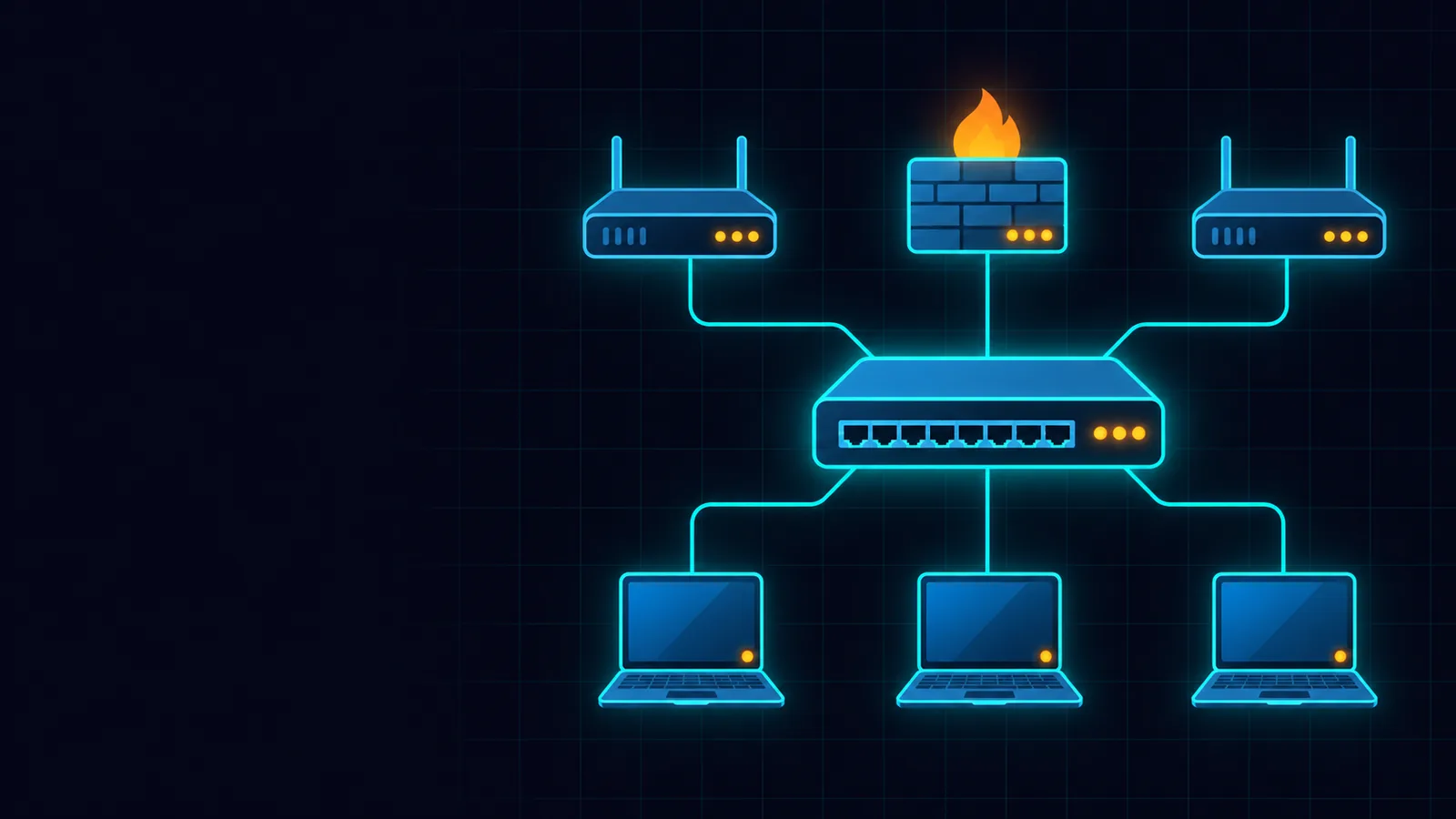
How CrushCert gets you exam-ready
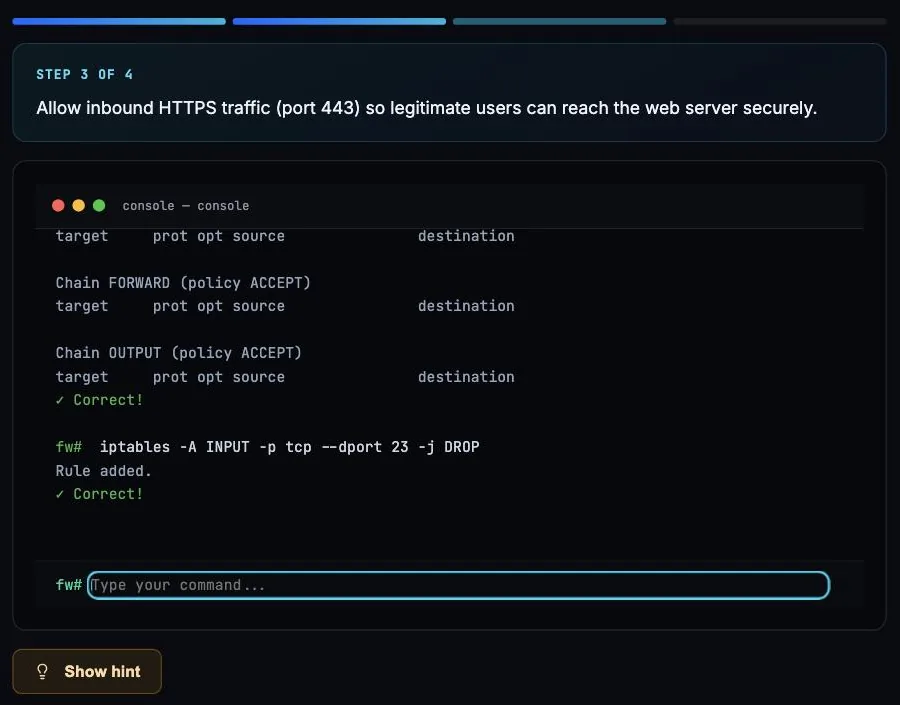
Hands-on labs
Drag-and-drop to match concepts and work through real troubleshooting scenarios — exactly the performance-based tasks the exam throws at you, not just multiple choice.
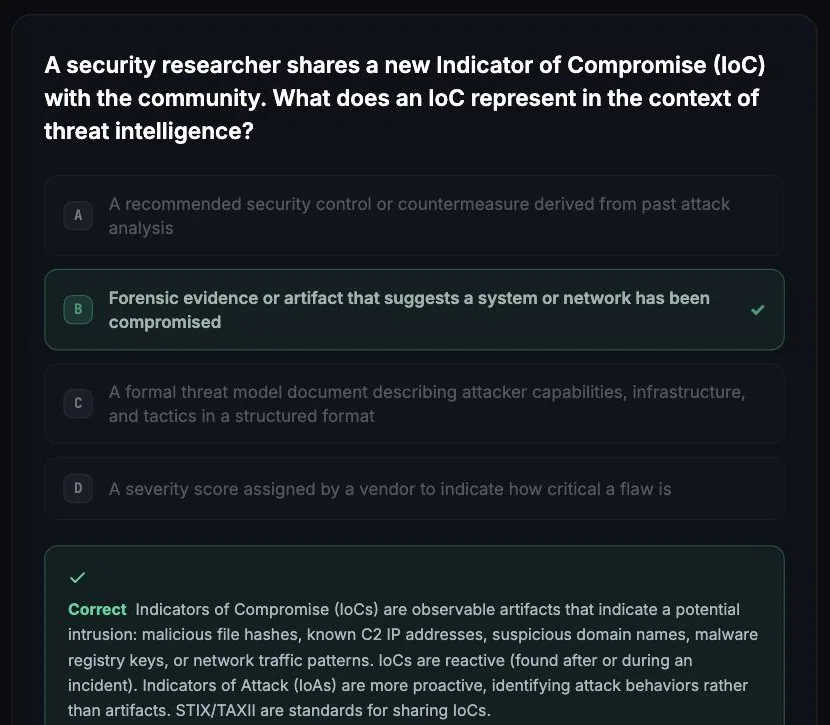
Adaptive practice
The algorithm tracks every question you miss and serves more of those topics, so your weak areas get more reps and every session moves your score.
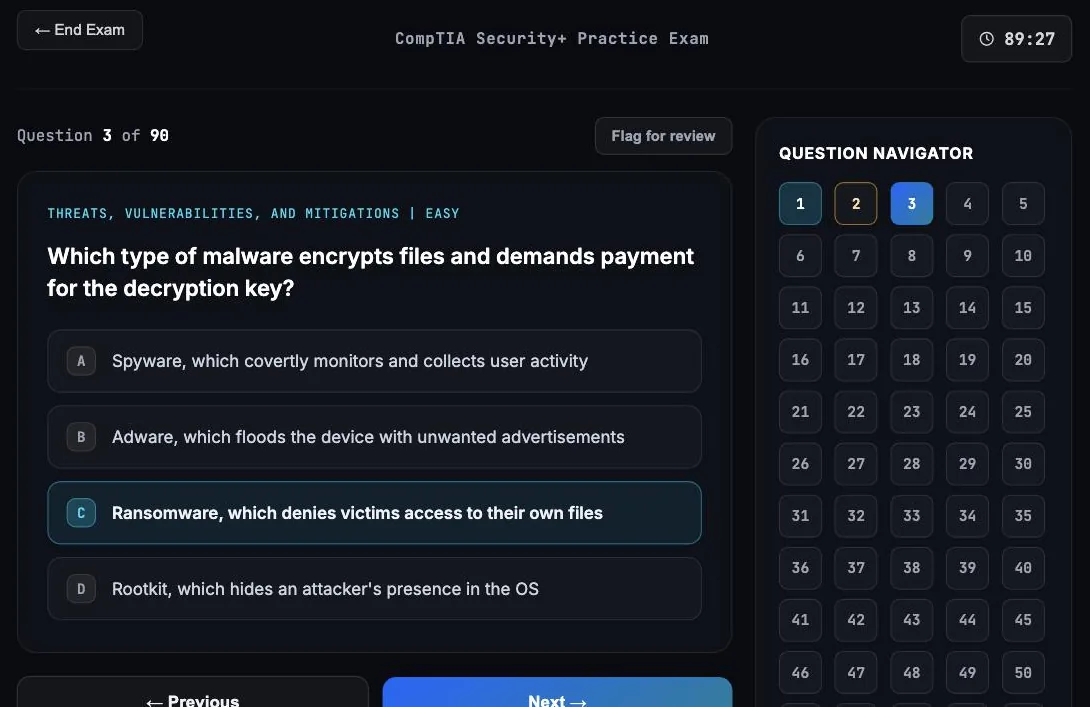
Realistic mock exams
Full-length, timed tests that mirror the real exam — countdown timer, question navigator, mark-for-review, and a 80% pass line so you know you're ready before exam day.
What studying looks like
Real screens from CrushCert's CompTIA track (shown: Security+), not mockups.
What's on the CompTIA Network+ exam
The Network+ (N10-009) has up to 90 questions in 90 minutes, scored on a 100–900 scale with a 720 passing score, and costs about $369. The five domains and weightings:
| Domain | Weight |
|---|---|
| Networking Concepts | 23% |
| Network Implementation | 20% |
| Network Operations | 19% |
| Network Security | 14% |
| Network Troubleshooting | 24% |
CrushCert's question bank and labs map to every domain. Hands-on lab and topic coverage includes:
Train on every domain above
Adaptive practice questions and hands-on labs mapped to these exact domains. 7 days free, no card required.
Start free trialFree CompTIA Network+ practice questions: are you ready?
Ten questions across all five exam domains. Answer each one, see the explanation, and find out which topic to work on first. No account needed.
Free readiness check
A Class C network uses a /24 mask (255.255.255.0) by default, leaving 254 usable host addresses. Every CrushCert question includes an explanation like this.
Fiber optic cables transmit data as pulses of light through glass or plastic strands.
A Service Level Agreement specifies measurable commitments (uptime, response times) and remedies. AUP governs acceptable use; NDA covers confidentiality.
OpenVPN uses UDP port 1194 by default. IPSec uses UDP 500/4500, PPTP uses TCP 1723.
"telnet [hostname] [port]" attempts to open a TCP connection to the specified port. If the port is open and listening, a connection is established. Test-NetConnection is the modern PowerShell equivalent (TcpTestSucceeded: True/False). ping uses ICMP and does not test specific TCP ports.
FTP uses port 21 for control/commands and port 20 for data transfer. SFTP uses port 22, TFTP uses UDP port 69.
Carrier MPLS services offer private any-to-any connectivity with traffic engineering and SLAs — though SD-WAN over broadband increasingly supplements or replaces it.
Port security limits learned MACs per port (sticky persists them in config) and can shut down or restrict on violation — stopping rogue devices.
An OTDR injects short light pulses into the fiber and measures the time and magnitude of reflections to locate faults — bends, breaks, bad splices — at a precise distance. A copper TDR does the same job but for copper cables. Toner probes only identify and trace cables; loopback plugs test port functionality.
Reducing the DHCP lease duration causes IP addresses to be returned to the pool more quickly when devices disconnect. This is the fastest short-term mitigation. The permanent solution (scope expansion or subnetting) requires planning. Configuring static IPs for all devices is impractical at scale.
Why learners pick CrushCert
You practice the way the exam tests you. The exam includes performance-based and scenario items — not just recall. Prep that's only flashcards leaves you guessing on test day. CrushCert's labs put you in the driver's seat.
Pay for one exam or all of them. Network+ alone is $10/month; the Associate plan is $19/month and covers CCNA, CompTIA A+, Network+, Security+, Azure Fundamentals, and several AWS exams — so if you're stacking certs, it's all included.
You always know your readiness. A live readiness score blends your quiz accuracy, mock results, and lab performance, and points you to exactly what to study next.
A guided plan tells you what to study today. Guided Learning builds a short daily plan from your performance — a warm-up review, a lesson on your weakest topic, flashcards, and a hands-on lab, all in about 20 minutes, with spaced repetition so material comes back right before you'd forget it.
Keep learning: CompTIA guides & path
Is CompTIA Network+ worth it in 2026?
The jobs it opens, salary impact, cost, and where Network+ fits vs A+, Security+, and CCNA.
STUDY PLANHow long to study for Network+ (N10-009)
Realistic timelines by experience level, total study hours, and a week-by-week 6-week plan.
CERT PATHSecurity+ vs Network+: which should you take first?
A clear comparison of difficulty, content, and careers — and how to decide which CompTIA cert to tackle first.
Continue your CompTIA path — CrushCert also covers A+, Security+, CySA+, CASP+ / SecurityX, and SecAI+, all in one plan.
Ready to crush the CompTIA Network+?
Adaptive questions, hands-on labs, and full mock exams — start free for 7 days, no card required.
Start studying freeCompTIA Network+ FAQ
How many questions are on the Network+ exam?
The N10-009 has up to 90 questions in 90 minutes, including multiple-choice and performance-based items.
Does CrushCert include hands-on Network+ labs?
Yes — drag-and-drop and troubleshooting scenarios covering subnetting, VLANs, routing, wireless, and network troubleshooting, matching the exam's performance-based questions.
What score do you need to pass Network+?
720 on a 100–900 scale. CrushCert mock exams use an 80% pass line so your practice mirrors the real bar.
How long does it take to study for Network+?
Typically 1–3 months. CrushCert's readiness score shows when you're consistently above the pass line.