CompTIA SecurityX (CASP+) practice test — with hands-on labs, not just flashcards
Most CompTIA SecurityX (CASP+) prep stops at multiple-choice questions. CrushCert adds hands-on labs built like the exam’s PBQs — the drag-and-drop and troubleshooting questions most people fail on — alongside 180+ adaptive practice questions and a full timed mock exam. Whether you know it as CASP, CASP+ or SecurityX, everything for the exam is here, in one place.
7 days free · No card required · Built to pass you on the first try
How CrushCert gets you exam-ready
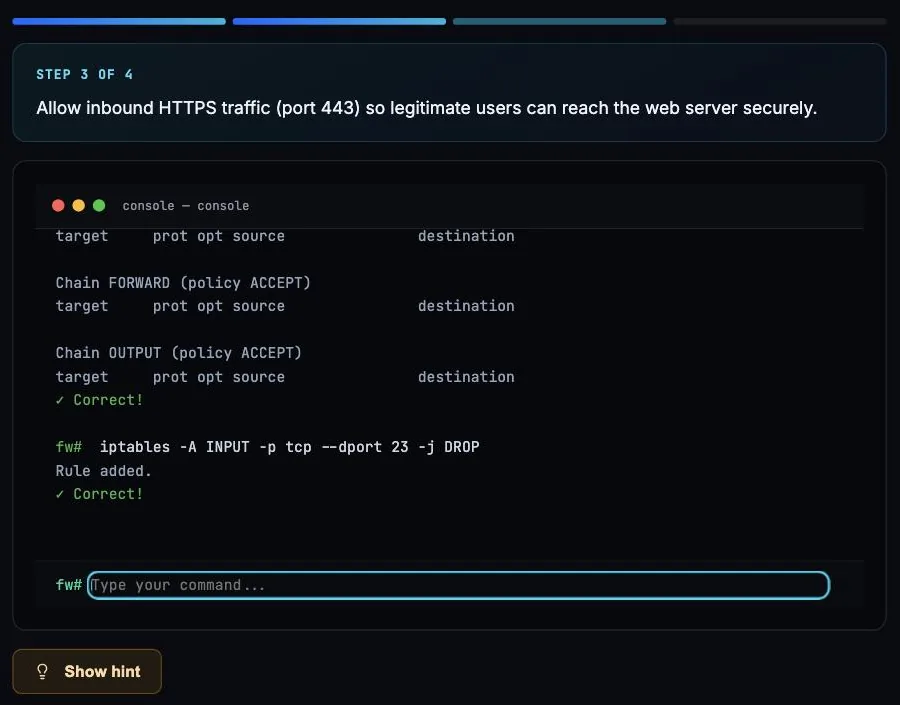
Hands-on labs
Drag-and-drop to match concepts and work through real troubleshooting scenarios — exactly the performance-based tasks the exam throws at you, not just multiple choice.
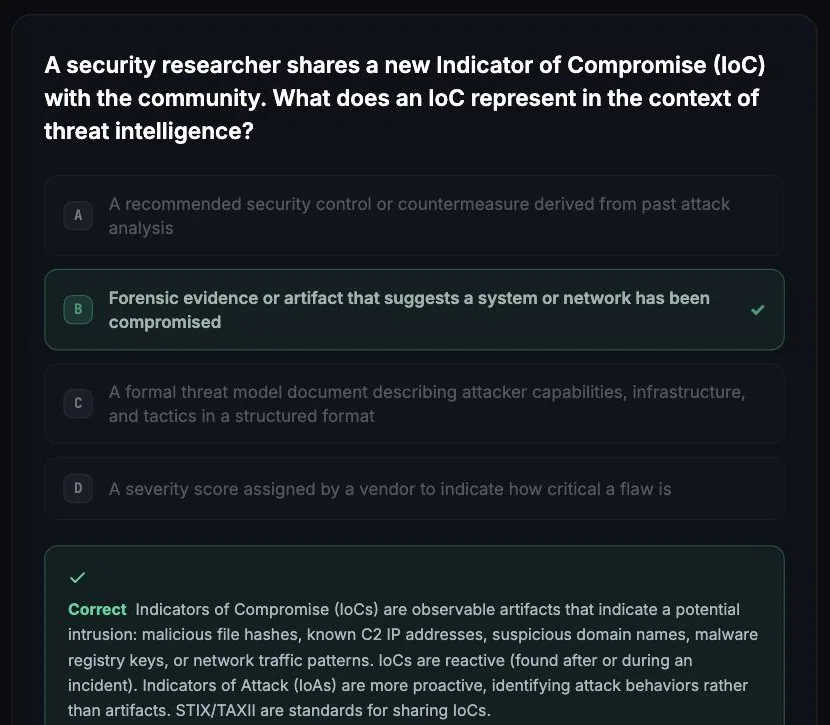
Adaptive practice
The algorithm tracks every question you miss and serves more of those topics, so your weak areas get more reps and every session moves your score.
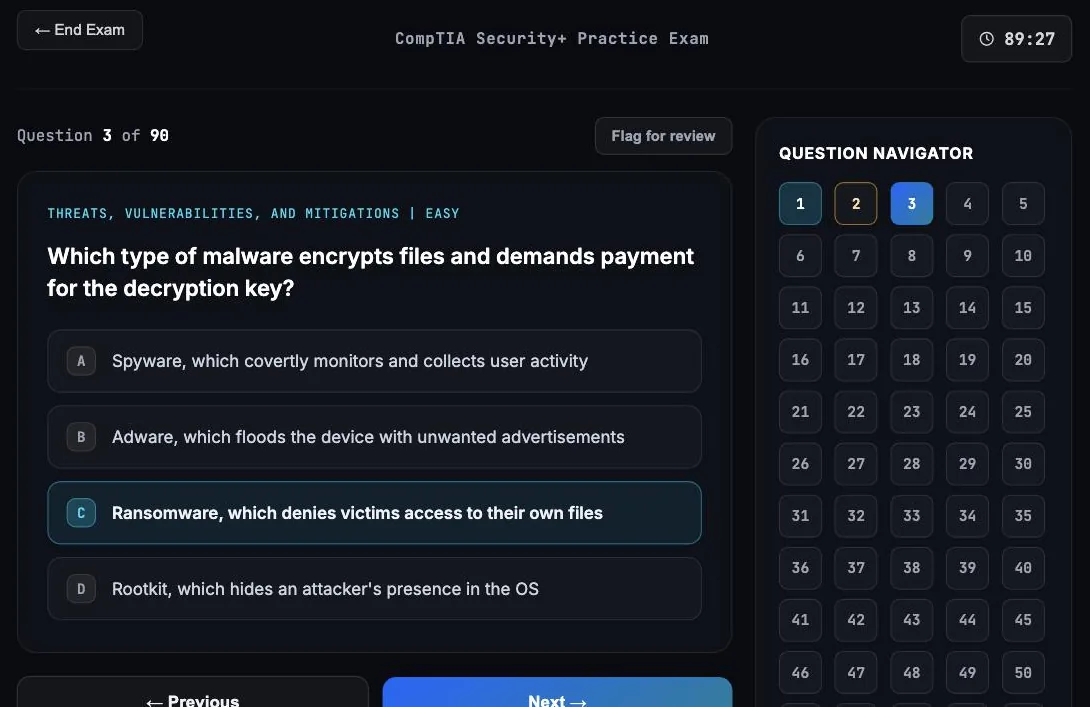
Realistic mock exams
Full-length, timed tests that mirror the real exam — countdown timer, question navigator, mark-for-review, and a 83% pass line so you know you're ready before exam day.
What studying looks like
Real screens from CrushCert's CompTIA track (shown: Security+), not mockups.
What's on the CompTIA SecurityX (CASP+) exam
SecurityX (CAS-005, formerly CASP+) has up to 90 questions in 165 minutes. CompTIA doesn't publish a cut score — it's pass/fail — and the exam costs about $529. The four domains and weightings:
| Domain | Weight |
|---|---|
| Governance, Risk & Compliance | 20% |
| Security Architecture | 27% |
| Security Engineering | 31% |
| Security Operations | 22% |
CrushCert's question bank and labs map to every domain. Hands-on lab and topic coverage includes:
Train on every domain above
Adaptive practice questions and hands-on labs mapped to these exact domains. 7 days free, no card required.
Start free trialFree CompTIA SecurityX (CASP+) practice questions: are you ready?
Ten questions across all four exam domains. Answer each one, see the explanation, and find out which topic to work on first. No account needed.
Free readiness check
ITIL (Information Technology Infrastructure Library) provides best practices for IT service management, including incident management, change management, and service desk operations.
TLS encrypts data in transit. MD5 and SHA-256 are hashing algorithms; RAID is a storage redundancy technique. Every CrushCert question includes an explanation like this.
Tokenization replaces sensitive data (like credit card numbers) with randomly generated tokens that maintain the same format. The mapping is stored in a secure token vault.
The containment phase focuses on limiting the scope and impact of an incident, preventing further spread while preserving evidence.
Annualized loss expectancy (ALE) translates technical risk into financial terms the board understands. It quantifies expected yearly losses from specific threats. Technical metrics like firewall rules and event counts are less meaningful to business leadership.
A DMZ is a network segment between an external and internal firewall that hosts public-facing servers (web, email, DNS).
A buffer overflow writes data beyond a buffer's boundary, overwriting the return address on the stack to redirect execution to attacker-controlled code. CSRF tricks browsers into making unauthorized requests, DNS poisoning corrupts name resolution, and ARP spoofing manipulates MAC-to-IP mappings.
SOAR (Security Orchestration, Automation, and Response) platforms automate repetitive security tasks like alert triage, enrichment, and response playbook execution. This reduces analyst workload, improves response times, and ensures consistent incident handling.
Zero-trust architecture requires verification of every access request regardless of whether it originates inside or outside the network. The core principle is 'never trust, always verify,' eliminating implicit trust based on network location.
Vulnerability scanning uses automated tools to identify known vulnerabilities without actively exploiting them. Penetration testing actively exploits vulnerabilities, red team exercises simulate full attacks, and social engineering tests human factors.
Why learners pick CrushCert
You practice the way the exam tests you. The exam includes performance-based and scenario items — not just recall. Prep that's only flashcards leaves you guessing on test day. CrushCert's labs put you in the driver's seat.
Pay for one exam or all of them. CASP+/SecurityX alone is $15/month; the Professional plan is $24/month and covers the CCNP core exams, AWS Solutions Architect and SA Pro, CySA+, CASP+/SecurityX, and SecAI+ — so if you're stacking certs, it's all included.
You always know your readiness. A live readiness score blends your quiz accuracy, mock results, and lab performance, and points you to exactly what to study next.
A guided plan tells you what to study today. Guided Learning builds a short daily plan from your performance — a warm-up review, a lesson on your weakest topic, flashcards, and a hands-on lab, all in about 20 minutes, with spaced repetition so material comes back right before you'd forget it.
Keep learning: continue your CompTIA path
Best CASP+ / SecurityX practice tests in 2026
The CASP+ to SecurityX rename explained, plus Jason Dion, CertMaster, and CrushCert compared for CAS-005.
CAREERIs CASP+ (CompTIA SecurityX) worth it in 2026?
Who this master-level cert is really for, salary reality, and why beginners should start elsewhere.
Continue your CompTIA path — CrushCert also covers A+, Network+, Security+, CySA+, and SecAI+, all in one plan.
Ready to crush the CompTIA SecurityX (CASP+)?
Adaptive questions, hands-on labs, and full mock exams — start free for 7 days, no card required.
Start studying freeCompTIA SecurityX (CASP+) FAQ
Is CASP+ the same as SecurityX?
Yes. CompTIA renamed CASP+ to SecurityX; the current exam code is CAS-005. It has up to 90 questions in 165 minutes.
Does CrushCert include hands-on SecurityX labs?
Yes — architecture and troubleshooting scenarios covering security architecture, risk, cryptography, and operations.
What score do you need to pass SecurityX?
CompTIA doesn't publish a cut score for this exam — it's reported pass/fail. CrushCert mock exams use an 83% pass line to keep practice rigorous.
How long does it take to study for SecurityX?
It's an advanced exam — many candidates spend 3–6 months. CrushCert's weak-area targeting focuses your time.