AI-901 practice test — know the AI ideas, then prove you can build with Microsoft Foundry
The AI-901 exam, Microsoft Azure AI Fundamentals, replaced AI-900 in 2026, and it is more hands-on than the old exam. About 40% is AI concepts: responsible AI, how generative models work and which workload fits a problem. The other 60% is building small things in Microsoft Foundry: deploying a model, writing a system prompt, creating an agent, and calling Azure Speech or Azure Content Understanding from a lightweight app. CrushCert drills both halves with 200 original practice questions at the official skill-area weights, each explaining why the right answer is right and why the others are wrong. Alongside them: five labs, flashcards with spaced repetition, and a 50-question timed mock exam.
7 days free · No card required · $10/mo for AI-901 alone
Up to date: written to Microsoft's skills outline of April 15, 2026, using current names (Microsoft Foundry, Foundry Tools, Azure Speech, Azure Language, Azure Content Understanding).
How CrushCert gets you exam-ready
Pick the right tool, then build with it
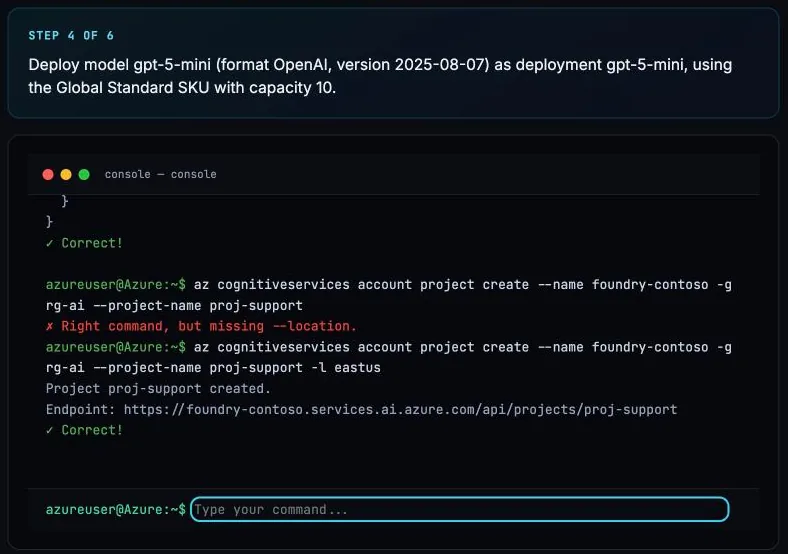
Most AI-901 misses come from choosing the wrong service or setting: a multimodal model or Azure Vision, Azure Speech or a model that hears audio, Content Understanding or a prompt. Four CrushCert labs make you match real requirements to the right principle, workload, setting and Foundry tool, and an Azure CLI lab has you deploy a model step by step.
Adaptive practice
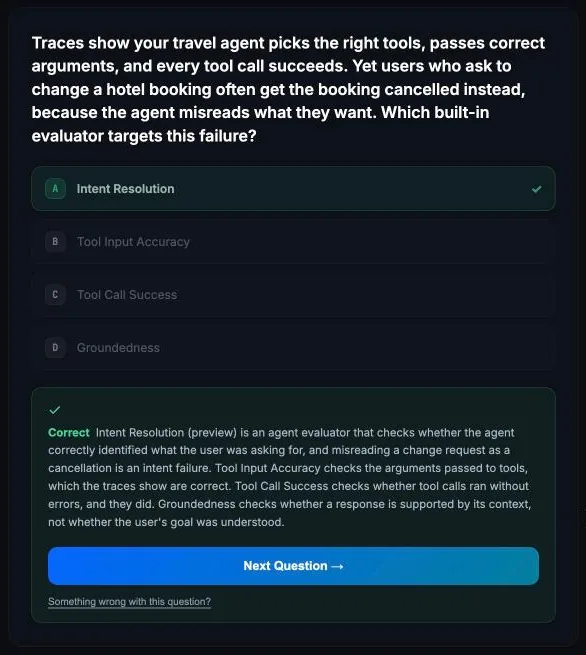
Quizzes prioritize questions you haven't seen and questions you missed, so your weak skill areas get more reps and every session moves your score.
Realistic mock exams
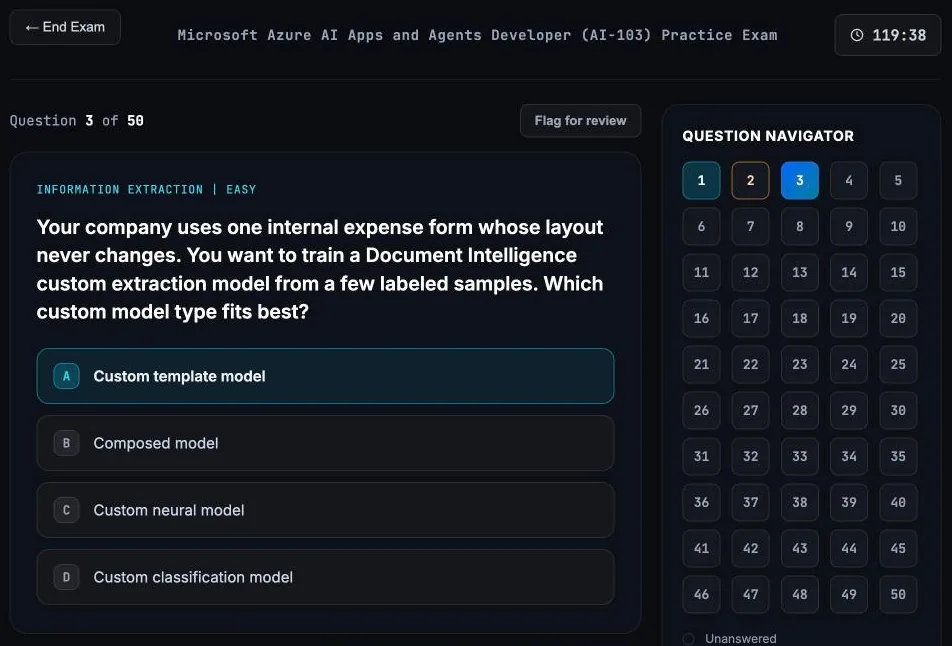
Timed tests of 50 questions on a 45-minute countdown, with a question navigator, mark-for-review, and a 70% pass line that mirrors the real 700 bar.
Every answer explained
All 200 questions are original, tagged to one of the seven outline areas, and were reviewed against Microsoft Learn by a separate reviewer. Each explanation covers why the right answer is right and why the tempting wrong ones are wrong.
What studying looks like
Real CrushCert screens from the live app, not mockups. Shown: AI-103, our Azure AI apps and agents exam; AI-901 uses the same quiz, lab and mock screens.
What's on the AI-901 exam
Exam AI-901, Microsoft Azure AI Fundamentals, earns the Microsoft Certified: Azure AI Fundamentals credential. Microsoft retired the old AI-900 exam on June 30, 2026, so AI-901 is now the only way to earn it. You need a scaled score of 700 to pass. Microsoft's exam page doesn't list the time limit or the number of questions, and it doesn't publish one global price; fundamentals exams are commonly about $99 in the US. Microsoft says most questions cover generally available features, and it expects candidates to know basic Python and to be familiar with REST APIs, SDKs and the command line. Fundamentals certifications don't expire. The two skill areas and their weights:
| Skill area | CrushCert questions | Exam weight |
|---|---|---|
| Identify AI concepts and capabilities | 85 | 40–45% |
| Implement AI solutions by using Microsoft Foundry | 115 | 55–60% |
These are the skills measured as of April 15, 2026. Inside the two skill areas, CrushCert's 200 questions are split across all seven outline topics: responsible AI (25), models and deployment (25), AI workloads (35), generative AI apps and agents (40), text and speech (25), vision and image generation (25), and information extraction with Content Understanding (25). Topic coverage includes:
Train on every skill area above
Adaptive practice questions and labs mapped to these exact skill areas. 7 days free, no card required.
Start free trialThe 5 hands-on AI-901 labs
Four drag-and-drop labs give you six real-world requirements each and ask you to match each one to the principle, workload, setting or Foundry tool that meets it, which is the decision most AI-901 questions turn on. The fifth is an Azure CLI lab where you create the resources and deploy a model yourself.
Name the principle, the workload and the setting
Match the Responsible AI Principle (fairness, reliability and safety, privacy and security, inclusiveness, transparency, accountability) · Pick the AI Workload (generative AI, agents, text analysis, speech, computer vision, information extraction) · Pick the Model or Setting (system prompt, temperature, max tokens, embedding model, multimodal model, image-generation model).
Choose the Foundry tool, then deploy a model
Pick the Foundry Tool (a deployed chat model, an agent with file search, Azure Language, Azure Speech, a multimodal model, Content Understanding) · Deploy a Model with the Azure CLI (resource group, Foundry resource, project, model deployment, role assignment).
"Pull the invoice number and total out of thousands of scanned PDFs"
→ Azure Content Understanding
"Read product descriptions aloud in a natural voice"
→ Azure Speech (text to speech)
"Answer staff questions using only the HR handbook"
→ An agent with file search
// mix up two tools and the lab shows you which match was wrong.
Ready to go deeper after AI-901? The AI-103 practice test is the associate-level next step for building Azure AI apps and agents.
Free AI-901 practice questions: are you ready?
Ten questions across both skill areas. Answer each one, see the explanation, and find out which area to work on first. No account needed.
Free readiness check
Outputs that reinforce stereotypes about groups of people are a fairness harm, because the system portrays groups differently based on characteristics like gender. Inclusiveness focuses on whether people with diverse needs and abilities can use and benefit from the system.
Lower temperature values make output more focused and deterministic, while higher values make it more random. Max tokens only limits how long the response can be.
Retrieval-augmented generation finds relevant content at query time and adds it to the prompt, so answers reflect current private data and can include citations. Fine-tuning is better for changing behavior or style and doesn't replace retrieval for current information.
Computer vision identifies the exhibit in the camera image, and speech synthesis (text to speech) reads the description aloud. Speech recognition would be needed only if visitors were speaking to the app.
The system prompt sets the assistant's role, tone and guardrails for every turn. The user prompt is the end user's own question, so rules placed there would depend on what each customer types.
File search grounds an agent in documents you upload; it parses, chunks and indexes them so the agent can retrieve relevant passages. Web search looks at the public internet, not internal files.
A conversation keeps history across turns, so the app creates one and sends each request with that conversation's ID. A new conversation per message would lose the earlier context.
Batch transcription processes large volumes of stored audio asynchronously, pointing at files with a SAS URI. Real-time transcription is designed for live audio streams, not large archives of recordings.
Multimodal models can interpret charts, screenshots and diagrams and explain them in plain language when given an image with a prompt. A GPT-image model creates or edits images rather than explaining them.
prebuilt-invoice is a domain-specific analyzer that already defines invoice fields such as amounts, dates and line items. prebuilt-documentSearch prepares documents for retrieval (markdown, summary, chunks) rather than returning invoice fields.
Why learners pick CrushCert
You practice the way the exam tests you. AI-901 is short scenarios — "a company wants… which should they use?" — where one clue decides the answer: the output must be the same every time; the app has to hear a spoken question; the fields come from scanned forms; users must know they are talking to AI. CrushCert's questions are built the same way, every distractor is a real Azure AI service, principle or setting you could confuse, and every explanation tells you why the tempting wrong choice is wrong.
Start with Microsoft's free material, then add reps. Microsoft Learn's free self-paced training covers the content, and Microsoft's AI-901 Practice Assessment on AI Skills Navigator is a good first check. CrushCert adds a 200-question bank at the official weights, five labs and a full-length timed mock, for people who want more practice than that.
It is a practice bank, not a course. CrushCert is practice questions, labs and mock exams, not a video course or an Azure sandbox. It suits people starting out in AI, developers and IT pros adding an AI credential, students, and people in sales, project or product roles who need to talk about Azure AI with confidence. New to Azure itself? See AZ-900.
You always know your readiness. A live readiness score blends your quiz accuracy, mock results, and lab performance, and points you to exactly what to study next.
A guided plan tells you what to study today. Guided Learning builds a short daily plan from your performance — a warm-up review, a lesson on your weakest topic, and flashcards, with spaced repetition so material comes back right before you'd forget it.
AI-901 pricing
$10/month
Microsoft Azure AI Fundamentals (AI-901) on its own: all 200 questions, the 5 labs, flashcards, mock exams, the readiness score and Guided Learning.
$19/month
All 11 Associate-tier exams, AI-901 included — worth it if you're pairing AI-901 with AZ-900 or another entry-level cert.
$24/month
All 24 exams across Cisco, CompTIA, AWS, ISC2 and Microsoft, including AI-103 for when you're ready for the next step.
7-day free trial · No card required · Cancel anytime · AI-901 is an Associate-tier exam
Keep learning: AI-901 reading
AI-900 vs AI-901: what changed
AI-900 retired on June 30, 2026. What AI-901 keeps, what it adds, and what that means if you started studying for AI-900.
COMPARISONBest AI-901 practice tests in 2026
Microsoft's free training and Practice Assessment first, then the paid options side by side — what you get, and who each one suits.
WORTH IT?Is the AI-901 worth it in 2026?
What the Azure AI Fundamentals cert honestly does for you, who it pays off for, and who can skip it.
TIMELINEHow long to study for the AI-901?
Typical timelines by background, from developers who already use Azure to people brand new to IT and coding.
STUDY PLANAI-901 study plan
A 2-week and a 4-week schedule across both skill areas, pairing Microsoft Learn and the Foundry quickstarts with practice questions and a timed mock.
NEXT STEPAI-103 Azure AI Apps and Agents practice test
The associate-level follow-on: plan, build and manage generative AI apps and agents on Azure.
Not sure which cert comes next? Take the two-minute Which certification should I take? quiz.
Ready to crush the AI-901?
200 original questions, five labs, explanations on every answer, and a timed mock exam — $10/month for AI-901, and the first 7 days are free with no card required.
Start studying freeAI-901 FAQ
Is the AI-901 hard?
It is a fundamentals exam, but it is more hands-on than the old AI-900. More than half of the outline (55 to 60%) is about building small solutions in Microsoft Foundry: deploying a model, writing system prompts, creating a single agent and calling Azure Speech or Azure Content Understanding from a lightweight app. Microsoft expects basic Python and some familiarity with REST APIs and SDKs. You need a scaled score of 700 to pass.
Did AI-901 replace AI-900?
Yes. Microsoft retired Exam AI-900 on June 30, 2026, and AI-901 is now the exam for the Microsoft Certified: Azure AI Fundamentals certification. AI-901 keeps the AI concepts from AI-900, such as responsible AI and AI workloads, and adds a larger, hands-on section on building with Microsoft Foundry.
How many questions are on the AI-901 exam?
Microsoft doesn't publish a question count or time limit on the AI-901 exam page. Microsoft fundamentals exams typically run about 45 minutes with roughly 40 to 60 questions, but check the confirmation when you book. You need a scaled score of 700 to pass. CrushCert's mock exam is 50 questions on a 45-minute timer with a 70% pass line that mirrors the 700 bar.
How long does it take to study for the AI-901?
Our estimate, at roughly 5 hours a week: about 2 weeks if you already build with Azure or write Python, about 3 to 4 weeks if you work in IT but are new to AI and Foundry, and about 5 to 6 weeks if you are new to both IT and coding. These are estimates, not guarantees; let your practice scores decide when you book.
Is there a free AI-901 practice test?
Yes. Microsoft offers an official AI-901 Practice Assessment on AI Skills Navigator (you sign in to take it), and Microsoft Learn's self-paced training for the exam is free too. Start there. The ten sample questions on this page are also free and need no account.
Does the AI-901 certification expire?
No. Microsoft fundamentals certifications, including Microsoft Certified: Azure AI Fundamentals, don't expire, so there is nothing to renew. Microsoft doesn't publish one global exam price; fundamentals exams are commonly about $99 in the US, and the price depends on the country where you test.
Is CrushCert enough on its own to pass the AI-901?
Use it alongside Microsoft Learn, not instead of it. CrushCert is practice questions, five labs and mock exams, not a video course or a sandbox. Work through Microsoft Learn's free AI-901 training, try the Foundry quickstarts in a free Azure account if you can, take Microsoft's Practice Assessment to find your gaps, then use CrushCert to drill the skill areas you still miss.