AI-103 practice test — drill the Foundry decisions the exam keeps asking about
The AI-103 exam, Developing AI Apps and Agents on Azure, gives you scenario after scenario and asks which Microsoft Foundry model, deployment type, agent tool, role or safety control fits. CrushCert drills exactly that: 300 original practice questions at the official skill-area weights, each explaining why the right answer is right and why every wrong answer is wrong. Alongside them: an Azure CLI lab where you type the az commands to stand up a Foundry resource, project, model deployment and role assignment, four drag-and-drop labs, flashcards with spaced repetition, and a 50-question, 120-minute timed mock exam.
7 days free · No card required · Built to pass you on the first try
Up to date: written to Microsoft's skills outline of April 16, 2026 — the only version on the study guide in November 2026 — using current names (Microsoft Foundry, Foundry Tools, Foundry Agent Service, Guardrails, Microsoft Agent Framework).

How CrushCert gets you exam-ready
Written for today's Foundry
Azure AI has been renamed a lot, and older study material still teaches the old names. Every CrushCert AI-103 question uses the names in the April 16, 2026 outline and current Microsoft Learn docs: Microsoft Foundry and Foundry Tools, Foundry Agent Service conversations and responses, Guardrails, Microsoft Agent Framework and the gpt-image family. Old names appear only where they help, such as “Foundry User (formerly Azure AI User)”, or as tempting wrong answers.
Adaptive practice
Quizzes prioritize questions you haven't seen and questions you missed, so your weak skill areas get more reps and every session moves your score.
Realistic mock exams
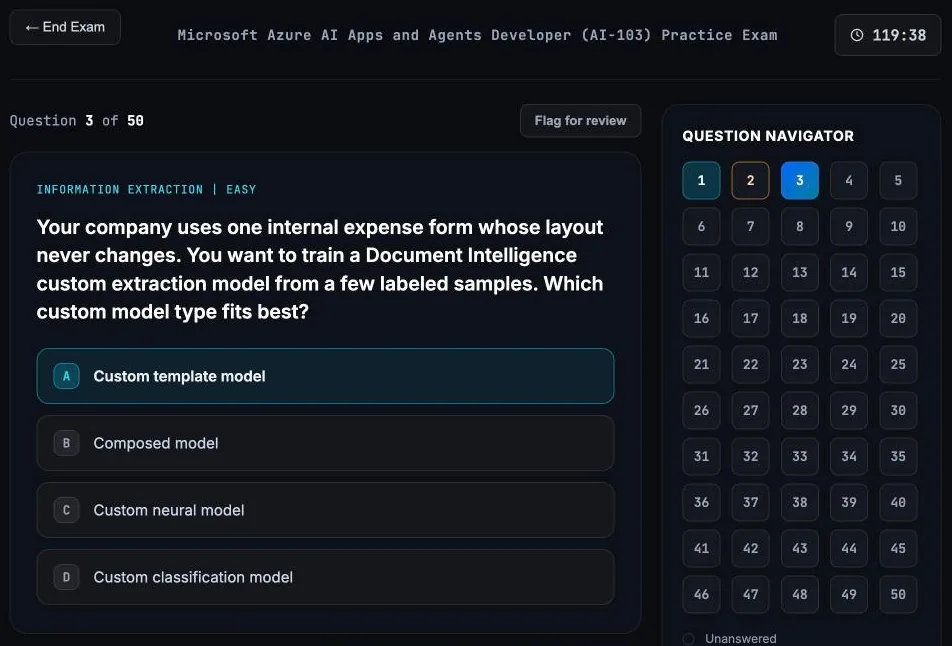
Timed tests of 50 questions on a 120-minute countdown, with a question navigator, mark-for-review, and a 70% pass line that mirrors the real 700 bar.
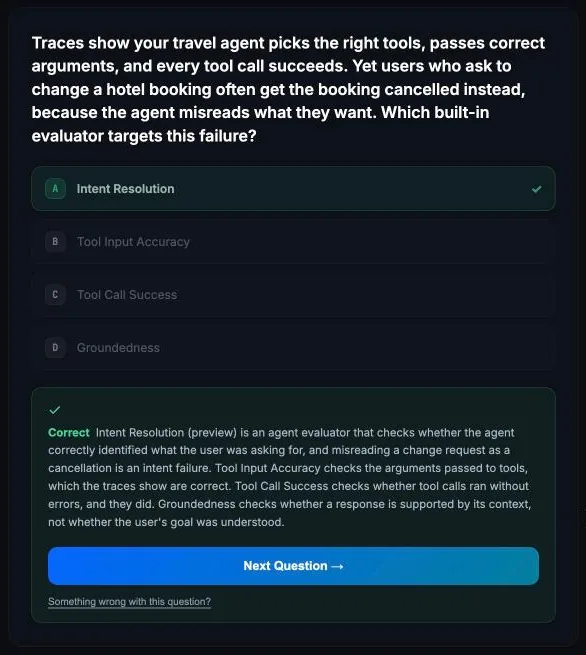
Every answer explained
All 300 questions are original, tagged to one of the 14 sub-objectives (1.1 through 5.2), and were checked against Microsoft Learn by a separate expert reviewer before launch. Each explanation covers why the right answer is right and why every wrong choice is wrong.
What studying looks like
Real CrushCert AI-103 screens from the live app, not mockups.
What's on the AI-103 exam
Exam AI-103, Developing AI Apps and Agents on Azure, earns the Microsoft Certified: Azure AI Apps and Agents Developer Associate credential. AI-103 replaced exam AI-102 (Azure AI Engineer Associate), which Microsoft retired on June 30, 2026. You get 120 minutes and need a scaled score of 700 to pass. Microsoft doesn't publish the number of questions (reports suggest 40 to 60), and the exam may include interactive components. Microsoft lists the price by country or region; in the US it's typically about $165. The certification renews yearly with a free online renewal assessment on Microsoft Learn, and Microsoft offers an official Practice Assessment and self-paced training. Microsoft says you should have experience developing apps with Python. The five skill areas and their weights:
| Skill area | CrushCert questions | Exam weight |
|---|---|---|
| Plan and manage an Azure AI solution | 82 | 25–30% |
| Implement generative AI and agentic solutions | 98 | 30–35% |
| Implement computer vision solutions | 40 | 10–15% |
| Implement text analysis solutions | 40 | 10–15% |
| Implement information extraction solutions | 40 | 10–15% |
These are the skills measured as of April 16, 2026, the only version on Microsoft's study guide in November 2026. CrushCert's 300 questions follow the official weights, and every question is tagged to one of the 14 sub-objectives. The bank includes role and least-privilege scenarios, deployment-type and quota questions, agent tool and MCP settings, structured-output schemas, image-edit masks and Azure AI Search query choices. Topic coverage includes:
Train on every skill area above
Adaptive practice questions and hands-on labs mapped to these exact skill areas. 7 days free, no card required.
Start free trialThe 5 hands-on AI-103 labs
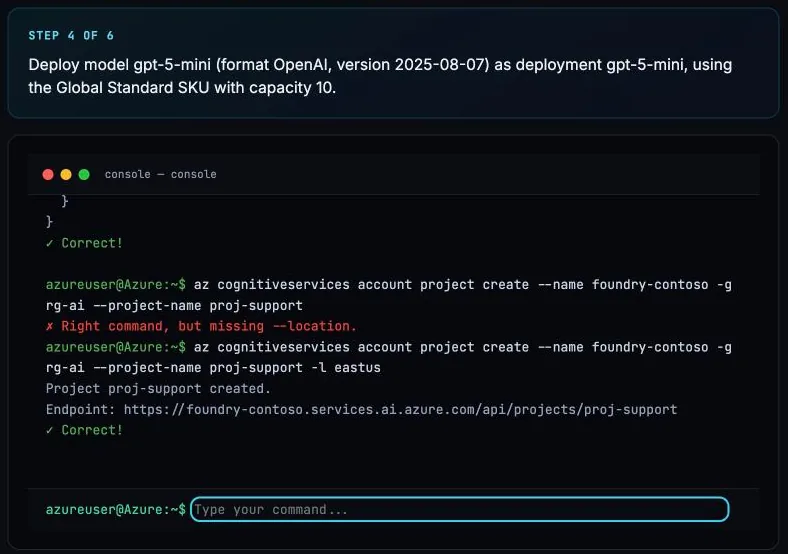
One lab is an Azure CLI command lab: you type the az commands a developer or platform engineer would run to set up Microsoft Foundry, and each step is checked. The other four are drag-and-drop labs that drill the choices the exam keeps asking about.
Set Up a Foundry Resource, Project and Model
Create a Foundry resource (az cognitiveservices account create), a Foundry project (az cognitiveservices account project create) and a Global Standard model deployment (az cognitiveservices account deployment create), then give a developer the least-privilege Foundry User role and check that the deployment finished. Flags can go in any order.
Make the right call
Pick the Right Foundry Tool (Speech, Document Intelligence, Content Understanding, Language, AI Search or Translator) · Build the RAG Pipeline in Order (chunk, embed, index, query, ground, evaluate) · Match the Safety Control (Prompt Shields, blocklists, evaluators, MCP approval) · Choose the Agent Tool (Web Search, File Search, Azure AI Search, Code Interpreter, OpenAPI, A2A).
azure:~$ az cognitiveservices account deployment create --name foundry-contoso --resource-group rg-ai --deployment-name gpt-5-mini --model-name gpt-5-mini --model-version 2025-08-07 --model-format OpenAI --sku-capacity 10 --sku-name GlobalStandard
# flags in any order · each step is checked · a wrong attempt gets a hint
The CLI lab is a simulation: nothing is deployed, and you don't need an Azure subscription to use it. For real hands-on practice, build a small app and an agent in Microsoft Foundry with your own Azure subscription.
Free AI-103 practice questions: are you ready?
Ten questions across all five exam domains. Answer each one, see the explanation, and find out which topic to work on first. No account needed.
Free readiness check
Global Standard is the default and recommended starting point: it gets new models first, has the lowest pay-per-token price and the highest quota. Data Zone Standard keeps processing inside a data zone, which isn't needed here, and it isn't the default starting point. Developer is only for evaluating fine-tuned models and has no SLA. Global Batch is for asynchronous jobs with a 24-hour target, not a live chat app. Every CrushCert question includes an explanation like this.
An empty allowed_tools list doesn't block anything; it allows all of the server's tools, which is a common trap. To block the server you should remove the MCP tool from the agent, and to limit it you should list only the tool names you want. The definition is valid, so it isn't rejected. allowed_tools and require_approval are separate settings, so approval status doesn't decide which tools are allowed.
input_fidelity controls how closely the output keeps the style and features, such as faces, of the input images. quality sets the overall rendering level (low, medium, high) but does not anchor the output to the input. output_compression only changes file size. partial_images controls how many in-progress previews are streamed back.
Fast transcription is designed for pre-recorded audio and returns the transcript synchronously, which suits a user waiting for one file. Batch transcription is asynchronous and meant for large volumes, so the user would have to wait for a job to finish. Real-time transcription streams live audio and would take at least as long as the recording. Speech translation translates speech into other languages, which isn't required here.
A hybrid query runs a BM25 full-text query, which matches exact tokens such as part numbers well, in parallel with a vector query for meaning, then merges them with RRF. Exhaustive KNN only makes the vector matches exact; embeddings still handle rare codes poorly. A larger k returns more neighbors that may still miss the exact code. Semantic reranking can only reorder candidates the vector query already found.
Standard (regional) processes data within the Azure geography and bills per token, which suits low or bursty traffic with a geography rule. Data Zone Standard can process data anywhere in the wider data zone, which is broader than one geography. Global Standard can use any Azure region. Regional Provisioned keeps data in the geography but reserves capacity, which wastes money on low, bursty traffic.
The {"never": [...]} form of require_approval lists tools that don't require approval, so search_tickets and get_ticket run without an mcp_approval_request. It doesn't block the tools; limiting which tools the agent can call is the job of allowed_tools. Approval on every call is the behavior of always, which is also the default when require_approval isn't set. require_approval and allowed_tools are separate settings, so a never list doesn't change allowed_tools.
Text embedded in an image is content from outside the conversation, so it should be treated like a document (indirect) attack and never as instructions. Indirect attack detection is off by default, so you must turn it on and test it with sample inputs. Prompt Shields for user prompt attacks focus on what the user types, not on hidden instructions in content. A stricter Violence setting doesn't catch injection, and a blocklist only stops one exact phrase.
Foundry Agent Consumer can only call agent endpoints, which makes it the least-privilege role for apps that consume agents. Foundry User can build and test agents, which is more than the app needs. Foundry Project Manager can also publish agents and assign roles. Contributor manages resources and can't call into the project's data plane at all.
In the current Agent Service, a thread maps to a conversation, messages map to items in that conversation, and a run maps to a response created with responses.create(). Agent versions replace assistants, not threads. Memory stores are long-term memory and traces are monitoring data, so neither replaces threads or runs. Workflows orchestrate several agents; they are not the replacement for a single run.
Why learners pick CrushCert
You practice the way the exam tests you. The AI-103 is mostly scenarios — "you are building… which should you use?" — where one constraint decides the answer: least privilege, data that must stay in the EU, no keys, the lowest cost for overnight jobs, or new development. CrushCert's questions are built the same way, every distractor is a real Foundry service, setting or role you could confuse, and every explanation tells you why the other choices are wrong.
It is a practice bank, not a course or a sandbox. CrushCert is practice questions, CLI and drag-and-drop labs and mock exams, not a video course and not a live Azure environment. Pair it with Microsoft Learn's self-paced AI-103 training and real build time in Microsoft Foundry, then use CrushCert to find the skill areas you still miss. It suits developers who already write Python, Azure administrators moving into AI, and AWS or CompTIA holders adding Microsoft's AI track.
You always know your readiness. A live readiness score blends your quiz accuracy, mock results, and lab performance, and points you to exactly what to study next.
A guided plan tells you what to study today. Guided Learning builds a short daily plan from your performance — a warm-up review, a lesson on your weakest topic, and flashcards, with spaced repetition so material comes back right before you'd forget it.
AI-103 pricing
$15/month
Microsoft Azure AI Apps and Agents Developer (AI-103) on its own: all 300 questions, the 5 labs, flashcards, mock exams, the readiness score and Guided Learning.
$24/month
All 23 exams across Cisco, CompTIA, AWS, ISC2 and Microsoft, AI-103 included — worth it if you're stacking certs.
7-day free trial · No card required · Cancel anytime · AI-103 is a Professional-tier exam, so the $19 Associate plan doesn't include it
Keep learning: AI-103 reading
Best AI-103 practice tests in 2026
Microsoft's official Practice Assessment and the paid options side by side — what you get, and who each one suits.
WORTH IT?Is the AI-103 worth it in 2026?
What the Azure AI Apps and Agents Developer Associate honestly does for you, who it pays off for, and why renewal costs nothing.
TIMELINEHow long to study for the AI-103?
Typical timelines by background, from Python developers who already use Azure to people new to Microsoft Foundry.
STUDY PLANAI-103 study plan
A schedule across the five skill areas, pairing Microsoft Learn and hands-on Foundry time with practice questions, labs and a timed mock.
NEW TO AZURE?AZ-900 Azure Fundamentals practice test
Not required for AI-103, but a gentler first step if Azure itself is new: 200 questions, six drag-and-drop labs and a 45-minute timed mock.
AZURE ADMINAZ-104 Azure Administrator practice test
The infrastructure side of Azure: identity, storage, compute and networking, with six Azure CLI command labs.
AI FOUNDATIONSAWS AI Practitioner practice test
New to AI and ML concepts? The foundational AWS AI exam covers models, RAG, and prompting from the ground up.
AI SECURITYCompTIA SecAI+ practice test
Securing AI systems, from CompTIA: exam-style questions, hands-on AI security labs and a timed mock exam.
Not sure which cert comes next? Take the two-minute Which certification should I take? quiz.
Ready to crush the AI-103?
300 original questions, an Azure CLI lab plus four drag-and-drop labs, explanations on every answer, and a timed mock exam — start free for 7 days, no card required.
Start studying freeAI-103 FAQ
Is the AI-103 hard?
It is a role-based associate exam for developers, so expect scenarios rather than definitions: you are building something, one constraint decides the answer, and you pick the model, deployment type, agent tool, role or safety control that fits. What trips people up is detail that looks similar: Contributor can deploy models but can't build in a Foundry project, an empty allowed_tools list allows every MCP tool, Global Batch versus provisioned throughput, File Search versus the Azure AI Search tool, and the Groundedness versus Relevance evaluators. The exam may also include interactive components. You have 120 minutes and need a scaled score of 700 to pass.
Do I need AZ-900 or other experience before AI-103?
Microsoft doesn't list a required exam for AI-103. The credential page says you should have experience developing apps with Python and be familiar with general AI, generative AI and Azure services. If Azure itself is new to you, AZ-900 is an optional, gentler first step.
How long does it take to study for the AI-103?
Our estimate, at roughly 6 to 8 hours a week: about 4 to 6 weeks if you're an Azure developer new to generative AI, about 8 to 10 weeks if you code in Python but are new to Azure, and 12 to 16 weeks or more if you're still learning to code. Building a small RAG app and an agent in Foundry yourself helps a lot.
How many questions are on the AI-103 exam?
Microsoft doesn't publish a question count for AI-103; reports suggest 40 to 60 questions. You get 120 minutes, need a scaled score of 700 to pass, and the exam may include interactive components. CrushCert's mock exam is 50 questions on a 120-minute timer with a 70% pass line that mirrors the 700 bar.
Is the Azure CLI lab a real Azure subscription?
No. The Azure CLI lab runs in a simulated Cloud Shell-style terminal: you type real az cognitiveservices commands to create a Foundry resource, a Foundry project and a Global Standard model deployment, then assign the Foundry User role, and each step is checked. Flags can go in any order. Nothing is deployed and no Azure subscription or cost is involved. For real hands-on practice, build in Microsoft Foundry with your own Azure subscription.
Which version of the AI-103 should I study, and is the bank updated when Microsoft changes the outline?
There is one version: the study guide's skills measured as of April 16, 2026, which is still the only version in November 2026, with no newer outline announced. Every CrushCert question is written to that version using current names such as Microsoft Foundry, Foundry Tools, Foundry Agent Service conversations and responses, Guardrails, Microsoft Agent Framework and the gpt-image family. Azure AI changes quickly, so we will update the bank when Microsoft updates the outline.
Does the Azure AI Apps and Agents Developer certification expire?
Yes, it renews yearly. Microsoft Certified: Azure AI Apps and Agents Developer Associate is renewed with a free online assessment on Microsoft Learn, so you don't pay for the exam again. Microsoft lists the exam price by country or region; in the US it's typically about $165.
Is CrushCert enough on its own to pass the AI-103?
Use it alongside Microsoft Learn, not instead of it. CrushCert is practice questions, five labs and mock exams, not a video course and not a live Azure sandbox. Work through Microsoft Learn's self-paced AI-103 training, build something real in Microsoft Foundry, take Microsoft's official Practice Assessment, then use CrushCert to drill the skill areas you still miss.