AZ-900 practice test — learn to tell look-alike Azure services apart
The AZ-900 is a fundamentals exam, but it is wide: cloud models, pricing, regions and zones, compute, networking, storage, identity, governance and monitoring, with plenty of services that sound alike. CrushCert gives you 200 original practice questions written to the official skill-area weights and tagged to the sub-objective they test (1.1 through 3.4), with an explanation on every question that says why the right answer is right and why each wrong one is wrong. Add six hands-on drag-and-drop labs, flashcards with spaced repetition, and a 50-question timed mock exam.
7 days free · No card required · Built to pass you on the first try
Up to date: written to Microsoft's skills outline of July 20, 2026, using current product names (Microsoft Entra ID, Defender for Cloud, Purview).

How CrushCert gets you exam-ready
Six hands-on drag-and-drop labs
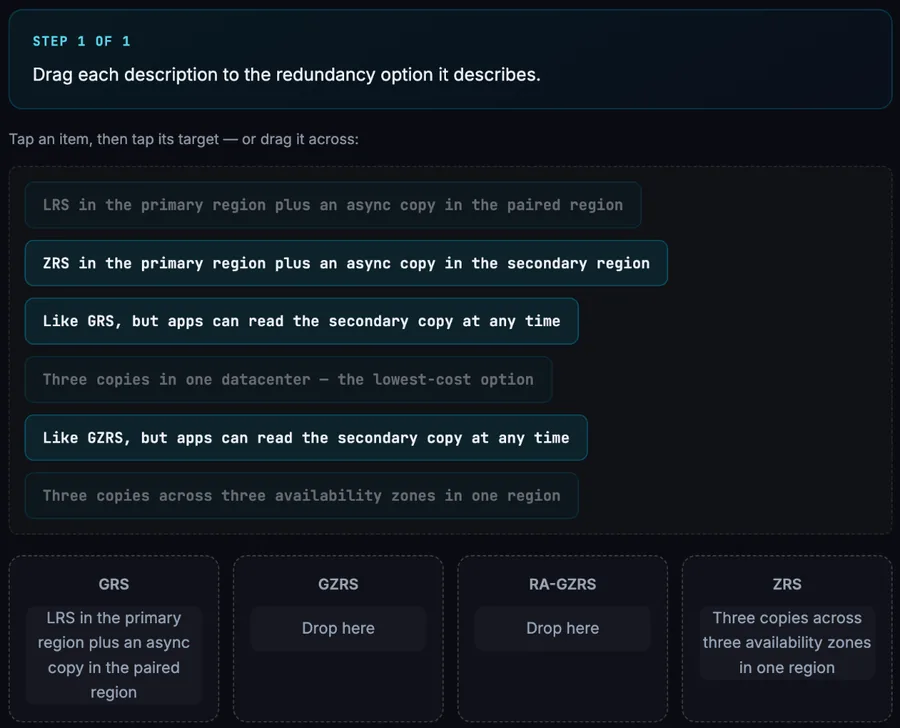
Built to mirror the exam's drag-and-drop items: Match the Cloud Model (IaaS, PaaS, SaaS, serverless, private, hybrid), Order the Azure Resource Hierarchy, Match the Storage Redundancy Option (LRS, ZRS, GRS, GZRS, RA-GRS, RA-GZRS), Pick the Network Service (VPN Gateway, ExpressRoute, peering, private endpoint, Azure DNS), Match the Governance Tool (locks, Policy, RBAC, tags, Purview, Conditional Access), and Match the Cost and Monitoring Tool (pricing calculator, Cost Management budgets, Advisor, Service Health, Log Analytics, Application Insights).
Adaptive practice
Quizzes prioritize questions you haven't seen and questions you missed, so your weak skill areas get more reps and every session moves your score.
Realistic mock exams
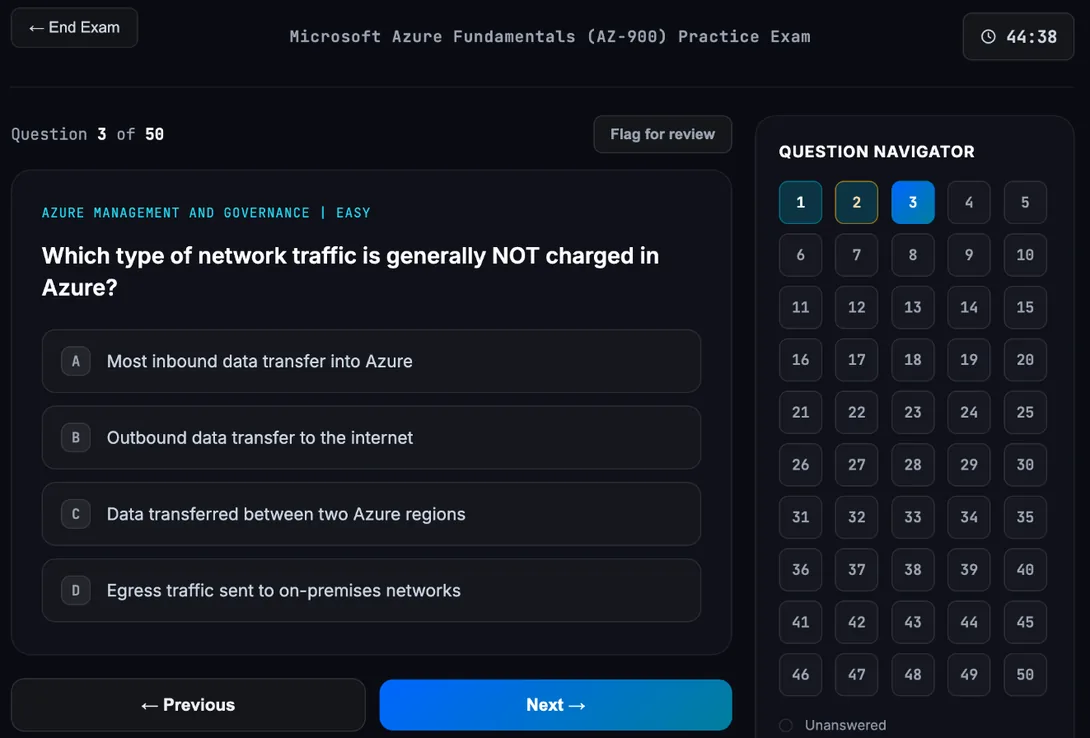
Timed tests of 50 questions on a 45-minute countdown, with a question navigator, mark-for-review, and a 70% pass line that mirrors the real 700-out-of-1000 bar.
Every answer explained
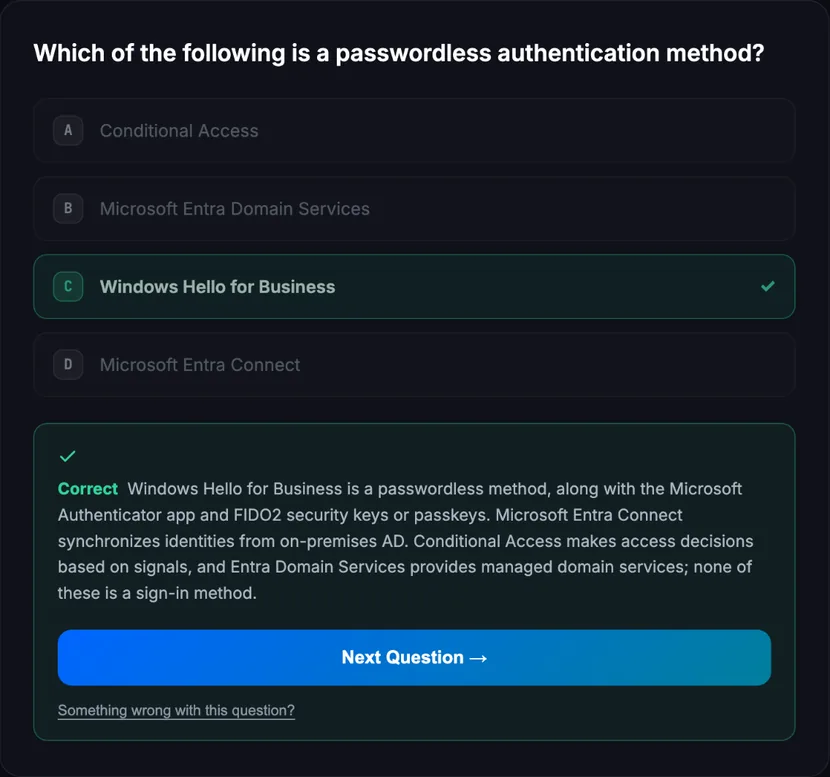
All 200 questions are original, tagged to their sub-objective (1.1 through 3.4), and went through two independent expert review passes before launch. Each explanation covers why the right answer is right and why every wrong choice is wrong.
What studying looks like
Real screens from the CrushCert AZ-900 track, not mockups.
What's on the AZ-900 exam
Exam AZ-900, Microsoft Azure Fundamentals, earns the Microsoft Certified: Azure Fundamentals credential. It costs $99 USD (the price varies by country) and gives you 45 minutes of answering time. Microsoft does not publish the question count; Microsoft exams typically have 40 to 60 questions. The passing score is 700 out of 1000 (scaled). Item types are single choice, multiple answer, drag-and-drop (order or match) and Yes/No statement sets; there are no labs and no case studies at this level. The credential does not require renewal, and Microsoft offers a free official practice assessment and a free learning path on Microsoft Learn. The three skill areas and their weights:
| Skill area | CrushCert questions | Exam weight |
|---|---|---|
| Describe cloud concepts | 55 | 25–30% |
| Describe Azure architecture and services | 75 | 35–40% |
| Describe Azure management and governance | 70 | 30–35% |
These are the skills measured as of July 20, 2026, the only current version of the exam. CrushCert's 200 questions follow the official weights, and every question is tagged to its sub-objective. Topic coverage includes:
Train on every skill area above
Adaptive practice questions and hands-on labs mapped to these exact skill areas. 7 days free, no card required.
Start free trialFree AZ-900 practice questions: are you ready?
Ten questions across all three exam domains. Answer each one, see the explanation, and find out which topic to work on first. No account needed.
Free readiness check
A hybrid cloud connects a private environment with a public cloud, letting regulated data stay on-premises while other workloads run in Azure. A public-cloud-only approach would not keep the regulated data in the company's own datacenter. A private-cloud-only approach would not use Azure for the other workloads. Multi-cloud means using several public providers, which does not address keeping data on-premises. Every CrushCert question includes an explanation like this.
ZRS stores three copies across three availability zones in the primary region, so it survives a zone failure without using a secondary region. LRS keeps all copies in a single datacenter, so a zone or datacenter failure could make data unavailable. GRS and RA-GRS replicate to a secondary region, which the company does not need, and in the primary region they use LRS rather than zones.
Azure Policy can require a tag and deny deployments that do not include it. An audit effect would only report missing tags, not reject the deployment. A ReadOnly lock blocks changes in general rather than checking tags, and Cost Management budgets track spending, not tag compliance.
OpEx is pay-as-you-go spending on services or products, and it is deducted in the same year it is spent. Upfront spending that depreciates over time describes CapEx. A one-time purchase of physical servers is also a capital expense. Owning the hardware is the CapEx model; with OpEx you pay for use without owning the infrastructure.
A VM requires a size, storage disks, an OS image, and networking (a virtual network, subnet, and network interface), but a public IP address is optional. A network interface is needed for the VM to connect to its virtual network. The OS image and VM size are core requirements for any VM.
Maintenance refers to keeping the environment clean, such as deleting unused or orphaned resources so they stop generating charges. Geography is about regional price differences. Subscription type relates to included allowances, and resource type is about how the kind of resource and its settings determine its price.
Reliability is the ability of a system to recover from failures and continue to function, and Azure's global regions let you design resilient apps. Elasticity is about automatically scaling with demand. Predictability is about being able to forecast performance and cost. Manageability covers how you manage the cloud and resources in it.
LRS keeps three copies within a single datacenter in the primary region and is the cheapest option, though it does not survive a datacenter-level disaster. ZRS spreads three copies across three availability zones. GRS and GZRS add an asynchronous copy to a secondary region, which costs more.
An action group defines the notifications and actions, such as email or SMS, that run when an Azure Monitor alert is triggered. Resource groups are logical containers for resources and are unrelated to alerts. An initiative groups Azure Policy definitions, and log data is queried with KQL in Log Analytics rather than stored in action groups.
Reservations (reserved instances) give a discount in exchange for a 1- or 3-year commitment, which suits a steady, always-on workload. Spot pricing is for interruptible work, because spot VMs can be evicted. Pay-as-you-go has no commitment and therefore no commitment discount. Azure Hybrid Benefit is about reusing existing Windows Server or SQL Server licenses, not committing to a resource.
Why learners pick CrushCert
You practice the way the exam tests you. The AZ-900 mixes plain "describe" questions with short scenarios — "a company wants… which service should it use?" — and most wrong answers are real Azure services that sound right. Every CrushCert question uses distractors a beginner would actually confuse, every explanation tells you why the other choices are wrong, and the six labs drill the matching and ordering tasks the exam's drag-and-drop items are built on.
It is a practice bank, not a course. CrushCert is practice questions, labs and mock exams, not a video course. Pair it with Microsoft Learn's free AZ-900 learning path, then use CrushCert to find the skill areas you still miss. It suits people new to cloud, non-technical roles such as sales, product management and finance that need Azure vocabulary, AWS people adding Azure, and anyone heading to AZ-104 or AI-103 later.
Pay for one exam or all of them. Azure Fundamentals alone is $10/month; the Associate plan is $19/month and covers ten Associate exams — CCNA, CompTIA A+, Network+, Security+, AWS Cloud Practitioner, AWS AI Practitioner, AWS Developer, CCNA Cybersecurity (CyberOps) and Azure Fundamentals — so if you're stacking certs, it's all included. The Professional plan is $24/month for all 23 exams. Cancel anytime.
You always know your readiness. A live readiness score blends your quiz accuracy, mock results, and lab performance, and points you to exactly what to study next.
A guided plan tells you what to study today. Guided Learning builds a short daily plan from your performance — a warm-up review, a lesson on your weakest topic, and flashcards, all in about 20 minutes, with spaced repetition so material comes back right before you'd forget it.
Keep learning: AZ-900 reading
Best AZ-900 practice tests in 2026
Microsoft Learn's free practice assessment, Tutorials Dojo, Dion Training, MeasureUp, CertCrush and CrushCert — price, question count, and who each one suits.
WORTH IT?Is the AZ-900 worth it in 2026?
A $99 entry-level cert with no renewal. What it honestly does for you, who it pays off for, and how it leads to AZ-104, AI-103 or SC-900.
TIMELINEHow long to study for the AZ-900?
Typically 1–2 weeks part-time with IT or cloud experience, and 3–4 weeks (roughly 15–25 hours) if you are new to cloud.
STUDY PLANAZ-900 study plan
A schedule across the three skill areas, pairing Microsoft Learn's free learning path with practice questions, labs and a timed mock.
Not sure which cert comes next? Take the two-minute Which certification should I take? quiz. Comparing clouds? CrushCert also covers the AWS Cloud Practitioner in the same Associate plan.
Ready to crush the AZ-900?
200 original questions, six hands-on labs, explanations on every answer, and a timed mock exam — start free for 7 days, no card required.
Start studying freeAZ-900 FAQ
Is the AZ-900 hard?
It is a fundamentals exam, so the questions test whether you can describe cloud concepts and Azure services, not configure them. There are no labs or case studies. What trips people up is breadth and look-alike services: ZRS versus GRS, Azure Policy versus RBAC versus resource locks, VPN Gateway versus ExpressRoute, Advisor versus Service Health versus Azure Monitor. You have 45 minutes of answering time and need 700 out of 1000 to pass.
How long does it take to study for the AZ-900?
Typically about 1 to 2 weeks part-time if you already work in IT or with another cloud (AWS Cloud Practitioner holders are often faster), and about 3 to 4 weeks part-time, roughly 15 to 25 hours in total, if you are new to cloud. Those are typical ranges, not a guarantee.
How many questions are on the AZ-900 exam?
Microsoft does not publish the question count; Microsoft exams typically have 40 to 60 questions. You get 45 minutes of answering time, and item types include single choice, multiple answer, drag-and-drop (order or match) and Yes/No statement sets. CrushCert's mock exam is 50 questions on a 45-minute timer with a 70% pass line that mirrors 700 out of 1000.
Which version of the AZ-900 should I study?
There is one current version: the study guide's skills measured as of July 20, 2026. It made only minor wording changes and kept the same three skill areas, and the AZ-900 is not on Microsoft's retirement list. Make sure your material uses the current product names, such as Microsoft Entra ID, Microsoft Defender for Cloud and Microsoft Purview. Every CrushCert question is written to that version.
Does the Azure Fundamentals certification expire?
No. Microsoft Certified: Azure Fundamentals does not require renewal. The exam costs $99 USD, and the price varies by country.
Is CrushCert enough on its own to pass the AZ-900?
Use it alongside Microsoft Learn, not instead of it. CrushCert is practice questions, six labs and a mock exam, not a video course. Work through Microsoft Learn's free AZ-900 learning path first, take Microsoft's free official practice assessment, then use CrushCert to drill the skill areas you still miss.