Cisco DCAI practice test — build and run the AI fabric
DCAI is Cisco's new AI infrastructure specialist exam and a CCNP Data Center concentration, and prep for it barely exists yet. CrushCert gives you 100 adaptive practice questions written to the official 300-640 topics — lossless Ethernet for RoCEv2 (PFC, ECN, ETS, DCQCN), GPU compute on UCS, storage for training and checkpoints, power and cooling, Nexus Dashboard, APIC, Intersight and Hyperfabric — with a written explanation on every answer, hands-on labs where you type the real NX-OS QoS config on a Nexus leaf, and a full timed mock exam.
7 days free · No card required · Built to pass you on the first try
How CrushCert gets you exam-ready
Written to the 300-640 exam topics
Questions are weighted exactly like the real exam — 20/30/30/20 across the four domains — so the mix you practice is the mix you'll face, with design and deployment getting the 60% they deserve.
Adaptive practice
The algorithm tracks every question you miss and serves more of those topics, so your weak areas get more reps and every session moves your score.
Realistic mock exams
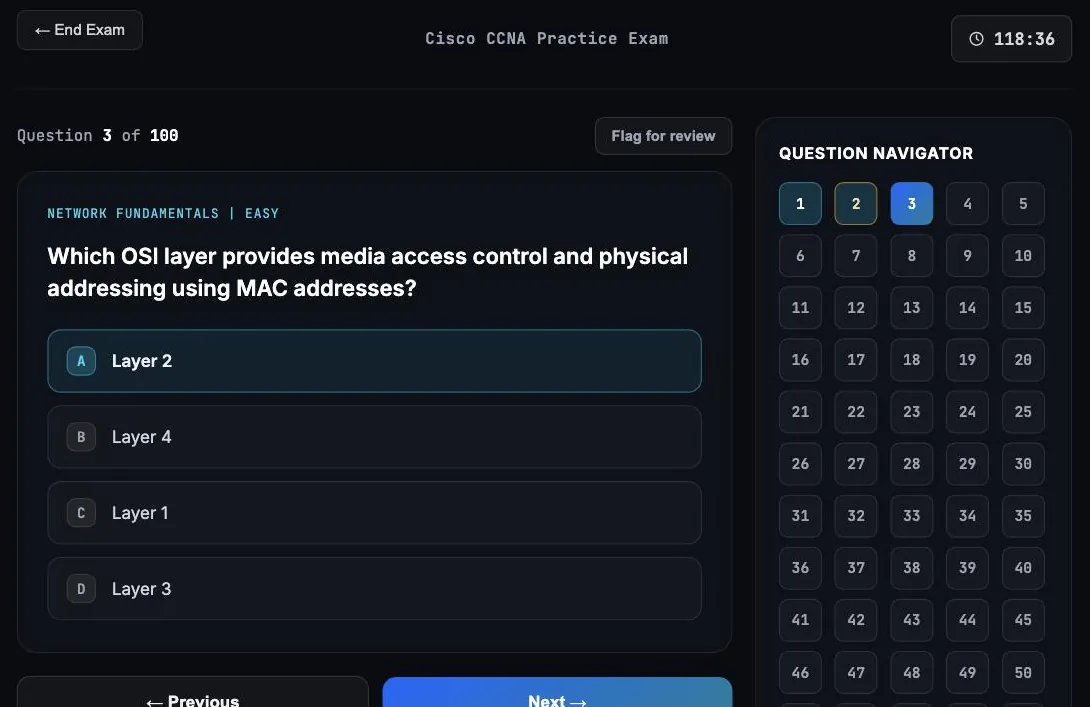
Full-length, timed tests that mirror the real exam — 60 questions, 90-minute countdown, question navigator, mark-for-review, and an 80% pass line so you know you're ready before exam day.
Type the real NX-OS config
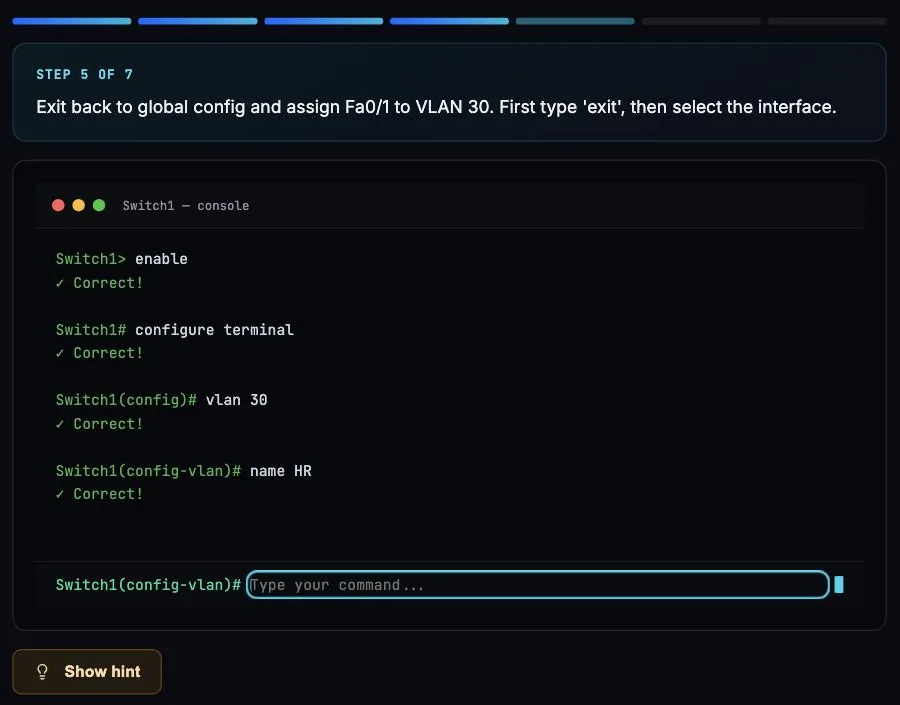
Most DCAI prep stops at multiple choice. CrushCert's command-line labs put you at a Nexus leaf prompt to build lossless RoCEv2 QoS yourself — PFC, a no-drop class, ECN marking and a priority queue for congestion signals — then use show commands to track down a port that's dropping RoCE traffic, with real abbreviations like conf t.
What studying looks like
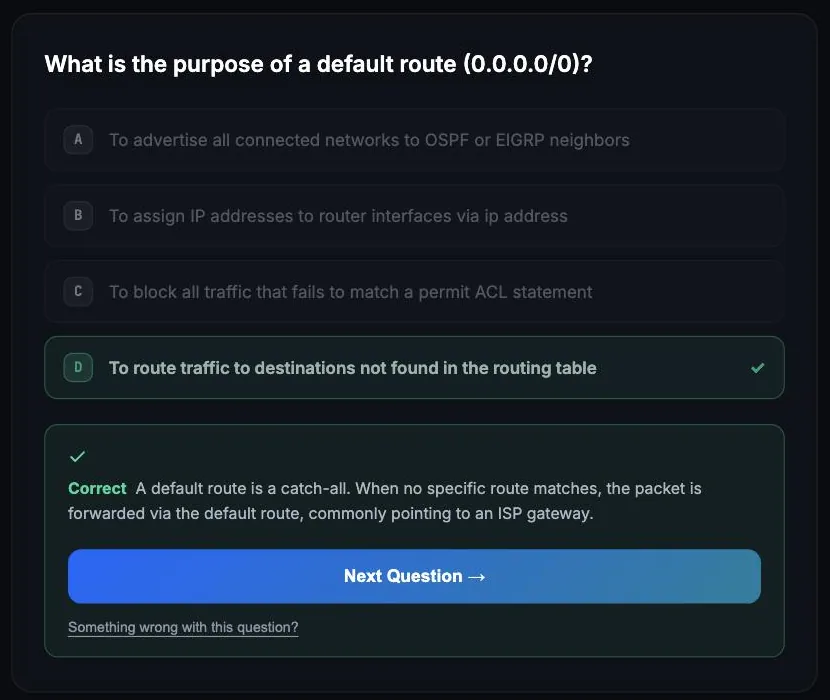
Real screens from CrushCert's Cisco track (shown: CCNA), not mockups.
What's on the Cisco DCAI exam
Implementing Cisco Data Center AI Infrastructure (300-640 DCAI) is a 90-minute exam that costs $300 USD. It earns the Cisco Certified Specialist – Data Center AI Infrastructure credential and counts as a concentration exam for CCNP Data Center. Cisco does not publish the question count or passing score. The four domains and weightings:
| Domain | Weight |
|---|---|
| AI fundamentals and applications | 20% |
| AI infrastructure components and architecture | 30% |
| AI infrastructure deployment and data management | 30% |
| AI infrastructure operations and troubleshooting | 20% |
CrushCert's question bank maps to every domain. Topic coverage includes:
Train on every domain above
Adaptive practice questions and hands-on labs mapped to these exact domains. 7 days free, no card required.
Start free trialFree Cisco DCAI practice questions: are you ready?
Ten questions across all four exam domains. Answer each one, see the explanation, and find out which topic to work on first. No account needed.
Free readiness check
Hybrid matches the two different requirements: sensitive data stays on controlled on-prem infrastructure, and non-sensitive experiments use elastic cloud GPUs. Sizing on-prem for peak wastes capacity, and edge nodes do not provide elastic training capacity.
The GPU computes on what is in its own high-bandwidth memory. Model, optimizer state, and activations all have to fit there, which is why large models are split across GPUs and nodes instead of relying on host RAM.
ECN marking is only a signal. The NIC that receives marked packets answers with CNPs, and the sending NIC's DCQCN logic cuts its rate. PFC pauses are the last-resort backstop, not the ECN reaction, and marked packets are never dropped. Every CrushCert question includes an explanation like this.
NCCL tests exercise the collectives distributed training depends on, so the result is the bus bandwidth the GPUs achieve through NVLink and the back-end fabric. It is the single best commissioning baseline for an AI fabric.
Cisco Hyperfabric AI is a cloud-managed AI fabric solution in which the switches and GPU server connectivity are designed, deployed, and monitored through a cloud service. Intersight server profiles configure UCS servers, not the fabric. APIC is the on-premises controller for ACI fabrics, and AI Canvas is an AI-driven collaborative operations workspace rather than a fabric management service.
On restart, hundreds of ranks read large contiguous slices of a multi-hundred-gigabyte checkpoint at the same time, so aggregate sequential read bandwidth decides how long the GPUs sit idle. Restore is read-heavy and sequential, not small random writes. Versioning and cost per terabyte are retention and budget concerns, not what gates restart time.
CoS lives in the 802.1Q header and does not survive a routed hop. End-to-end classification in a Layer 3 fabric has to key on DSCP, carried in the IP header, and the NICs must mark it consistently.
CRC and FCS errors mean frames arrived corrupted, which is a signal-integrity issue on the physical link rather than a queueing issue. Congestion and hash imbalance show up as output discards, PFC pauses, or high utilization rather than corrupted frames, and an aggressive ECN threshold only increases marked packets, not errors.
NVMe-oF extends the NVMe command set across a network fabric, and the RoCEv2 and TCP transports let it run over standard Ethernet with low latency. iSCSI is an older SCSI-based block protocol with more protocol overhead than NVMe-oF. NFS is a file protocol, not block, and FCoE encapsulates Fibre Channel frames, so it still requires FCoE-capable lossless switches and FC forwarders rather than running over the existing Ethernet network.
Data Center Bridging Exchange uses LLDP TLVs to advertise PFC enablement per priority and ETS bandwidth groups; a NIC in willing mode accepts those values, keeping the fabric and hosts consistent. DCBX is not CDP-based and does not transfer NX-OS policy configuration. It also has nothing to do with ECN or DCQCN congestion control, which remain required.
Why learners pick CrushCert
You practice the way the exam tests you. DCAI is scenario-heavy — "a training job slowed down after a new leaf was added, what is the MOST likely cause?" — not definition recall. Every CrushCert question is written in that style, every explanation tells you why the other three choices are wrong, and hands-on labs drill the judgment calls — naming the lossless-Ethernet mechanism, matching workloads to what they need, picking the right Cisco tool, and working a RoCEv2 troubleshooting ticket from counters to fix.
Pay for one exam or all of them. Cisco DCAI alone is $15/month; the Professional plan is $24/month and covers all 24 exams — CCNP Data Center, CCNP Enterprise, CCNP Security, AWS Solutions Architect, CySA+ and more — so if you're stacking certs, it's all included.
You always know your readiness. A live readiness score blends your quiz accuracy, mock results, and lab performance, and points you to exactly what to study next.
A guided plan tells you what to study today. Guided Learning builds a short daily plan from your performance — a warm-up review, a lesson on your weakest topic, and flashcards, all in about 20 minutes, with spaced repetition so material comes back right before you'd forget it.
Keep learning: Cisco data center path
CCNP Data Center (DCCOR) practice test
The 350-601 core exam DCAI pairs with for CCNP Data Center — Nexus, ACI, UCS, storage networking and automation.
RELATEDCCNP Enterprise practice test
Coming from the enterprise side? ENCOR covers the routing, QoS and automation fundamentals DCAI builds on.
STUDY PLANCisco DCAI study plan
A day-by-day 3-week or 6-week schedule, plus cheat sheets for lossless Ethernet and the counters that diagnose a slow AI fabric.
COMPARISONBest Cisco DCAI practice exams in 2026
What actually exists for 300-640 — Cisco U, the five-day course, Udemy sets, CrushCert — and the dump sites to avoid.
TIMELINEHow long to study for Cisco DCAI?
Most DCCOR holders need 3–6 weeks (30–60 hours). Two weeks if you already build GPU fabrics; longer if you're new to data center.
WORTH IT?Is Cisco DCAI worth it in 2026?
Who the $300 specialist exam pays off for, who should skip it, and how it compares with AITECH and AWS AI Practitioner.
AI FOUNDATIONSAWS AI Practitioner practice test
New to AI workloads? The foundational AWS AI exam explains training, inference, RAG and generative AI from the ground up.
Not sure which cert comes next? Take the two-minute Which certification should I take? quiz.
Ready to crush Cisco DCAI?
Adaptive questions, hands-on labs, explanations on every answer, and full mock exams — start free for 7 days, no card required.
Start studying freeCisco DCAI FAQ
What is the Cisco DCAI 300-640 exam?
300-640 DCAI (Implementing Cisco Data Center AI Infrastructure) is a 90-minute Cisco exam that earns the Cisco Certified Specialist – Data Center AI Infrastructure credential. It also counts as a concentration exam toward CCNP Data Center, so you can pair it with the DCCOR 350-601 core exam. It costs $300 USD.
How many questions are on the DCAI exam and what is the passing score?
Cisco does not publish question counts or passing scores for its exams. CrushCert's DCAI mock exams use 60 questions in 90 minutes with an 80% pass line, the same settings we use for the other CCNP-level Cisco exams.
What does the DCAI exam cover?
Four domains: AI fundamentals and applications (20%), AI infrastructure components and architecture (30%), AI infrastructure deployment and data management (30%), and operations and troubleshooting (20%). In practice that means lossless Ethernet for RoCEv2 (PFC, ECN, ETS, DCQCN), GPU compute on Cisco UCS, storage for training and checkpoints, power and cooling, and Cisco tools such as Nexus Dashboard, APIC, Intersight, and Hyperfabric AI.
Should I take DCCOR or DCAI first?
If you are working toward CCNP Data Center, most people take the DCCOR 350-601 core exam first, because DCAI assumes you already know Nexus, NX-OS QoS, and UCS basics. If you only want the AI Infrastructure specialist badge, DCAI on its own is fine. CrushCert covers both on one plan.