CCNP Data Center (DCCOR) practice test — with hands-on labs, not just flashcards
Most CCNP Data Center (DCCOR) prep stops at multiple-choice questions. CrushCert adds hands-on labs where you type live Cisco IOS commands into a pre-built topology — no Packet Tracer setup, no simulator to buy — alongside 140+ adaptive practice questions and a full timed mock exam. Everything for the exam, in one place.
7 days free · No card required · Built to pass you on the first try
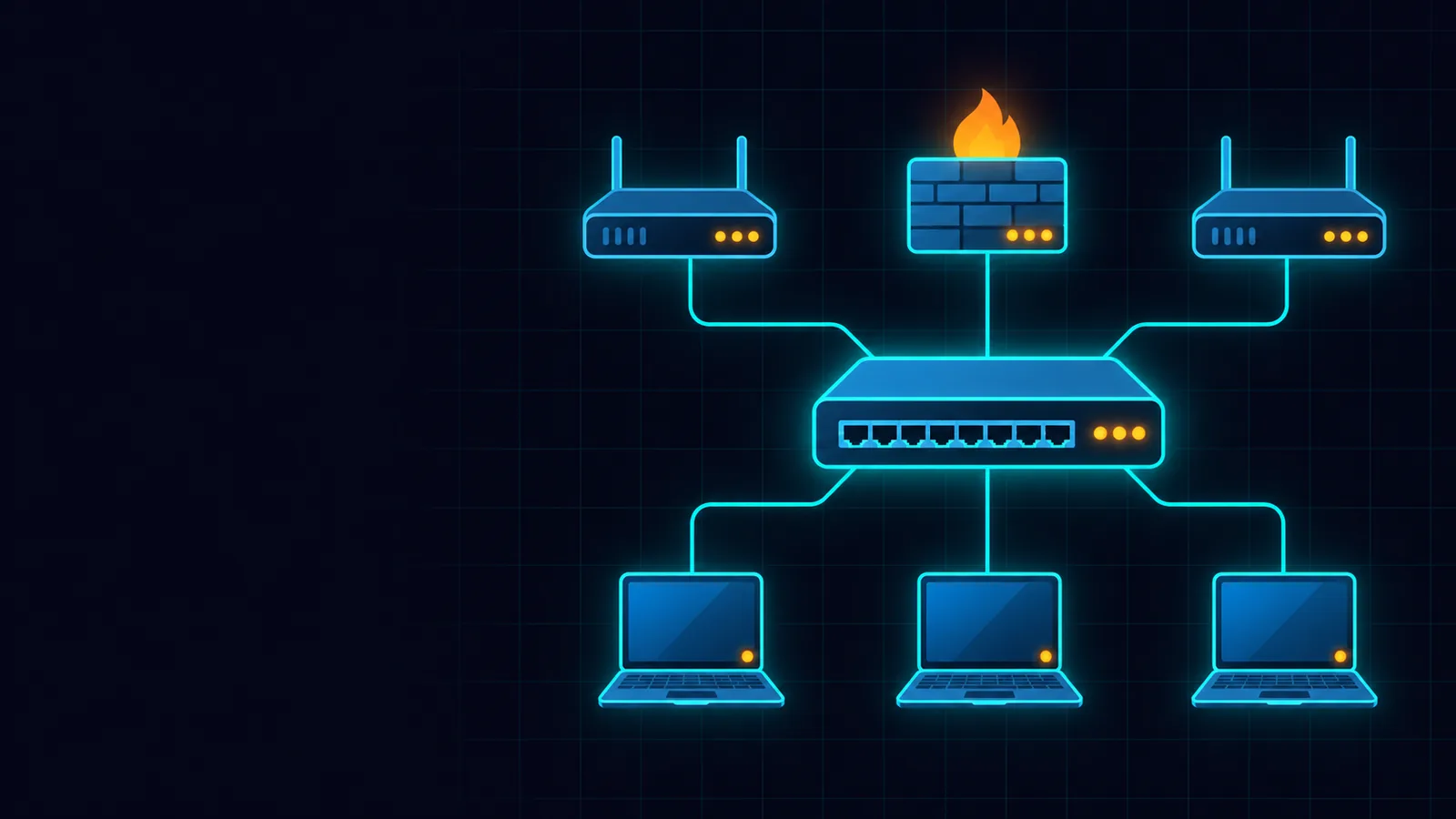
How CrushCert gets you exam-ready
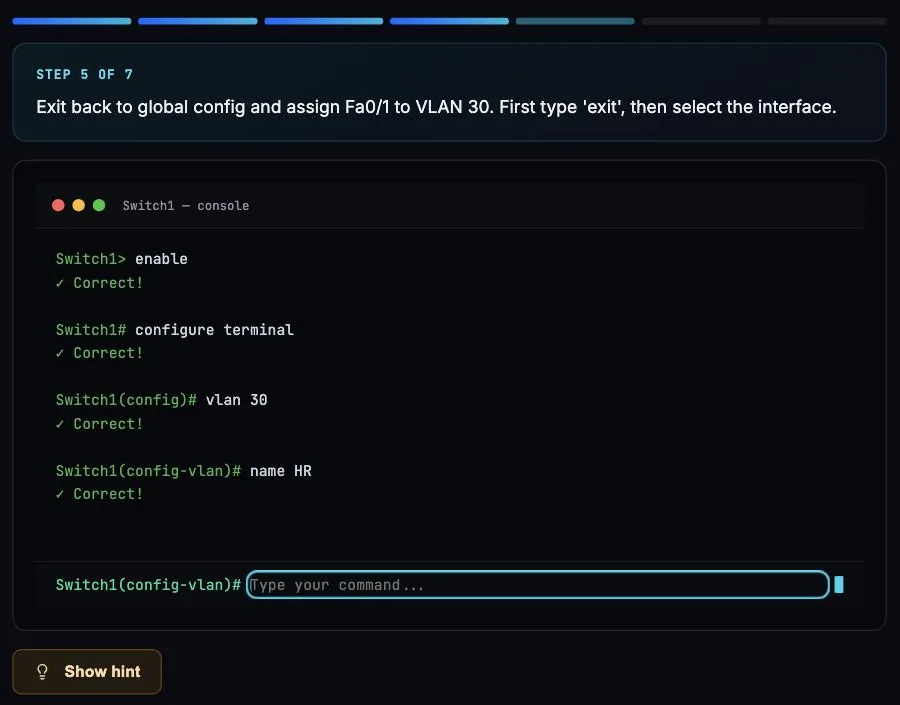
Hands-on Cisco labs
Type real Cisco IOS commands into a simulated terminal, then drag-and-drop and troubleshoot live topologies. This is where the exam is won — and what flashcard apps can't give you.
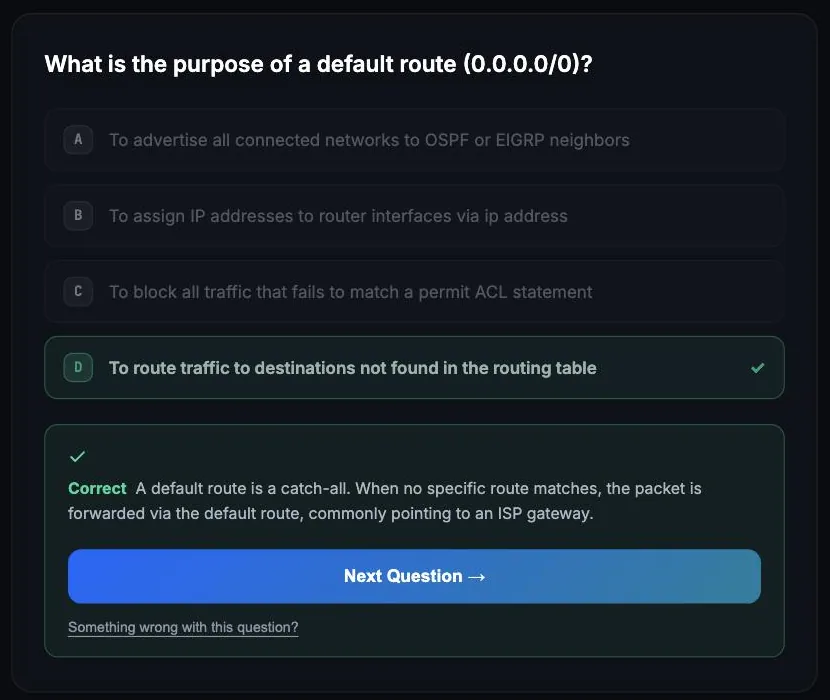
Adaptive practice
The algorithm tracks every question you miss and serves more of those topics, so your weak areas get more reps and every session moves your score.
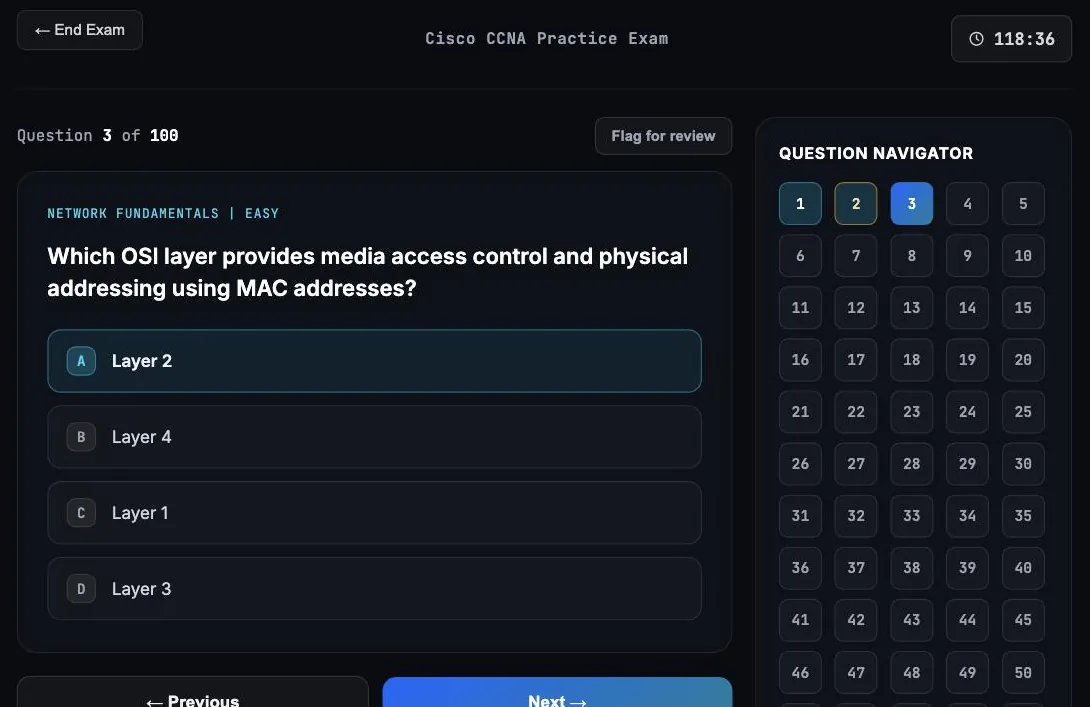
Realistic mock exams
Full-length, timed tests that mirror the real exam — countdown timer, question navigator, mark-for-review, and a 80% pass line so you know you're ready before exam day.
What studying looks like
Real screens from CrushCert's Cisco track (shown: CCNA), not mockups.
What's on the CCNP Data Center (DCCOR) exam
DCCOR (350-601) is the CCNP Data Center core exam: 120 minutes, about $400. Cisco doesn't publish an official cut score. The five domains and weightings:
| Domain | Weight |
|---|---|
| Network | 25% |
| Compute | 25% |
| Storage Network | 20% |
| Automation | 15% |
| Security | 15% |
CrushCert's question bank and labs map to every domain. Hands-on lab and topic coverage includes:
Train on every domain above
Adaptive practice questions and hands-on labs mapped to these exact domains. 7 days free, no card required.
Start free trialFree CCNP Data Center (DCCOR) practice questions: are you ready?
Ten questions across all five exam domains. Answer each one, see the explanation, and find out which topic to work on first. No account needed.
Free readiness check
Virtual Port Channel (vPC) lets two Nexus switches present themselves as a single logical device to a downstream switch or server. Every CrushCert question includes an explanation like this.
vNIC templates define network interface settings including VLANs, MTU, failover policies, and QoS. They can be referenced by service profiles or templates to ensure consistent network configuration across multiple servers.
An F_Port (Fabric port) is a switch port that connects to a server's N_Port (Node port) HBA. The F_Port is the access-layer connection point in a Fibre Channel SAN fabric.
NX-API REST uses JSON as its default data encoding format. It also supports XML. The API endpoint is accessed via HTTPS and returns structured data that can be easily parsed by automation tools and scripts.
MKA (MACsec Key Agreement), defined in IEEE 802.1X-2010, is the protocol used to discover peers, negotiate cipher suites, and distribute encryption keys (SAKs) for MACsec sessions between directly connected devices.
Contracts (containing subjects and filters) are provided by one EPG and consumed by another, defining permitted traffic between them.
I/O Modules act as fabric extenders (FEX): all blade traffic is forwarded to the parent Fabric Interconnect where switching and policy occur, simplifying management.
Multipath I/O (MPIO) provides redundancy and optionally load balancing by using multiple network paths between an iSCSI initiator and target. If one path fails, I/O continues on the remaining paths.
VXLAN encapsulates Layer 2 frames in UDP over a Layer 3 underlay and uses a 24-bit VNI (about 16 million segments), far exceeding the 4094 VLAN limit; BGP EVPN is the common control plane. PPP and Frame Relay are legacy WAN encapsulations.
A service profile template defines a standard configuration from which many service profiles are generated, ensuring consistency and rapid provisioning. Updating templates can propagate changes to associated profiles. The other options do not provision servers.
Why learners pick CrushCert
You practice the way the exam tests you. The exam includes performance-based and scenario items — not just recall. Prep that's only flashcards leaves you guessing on test day. CrushCert's labs put you in the driver's seat.
Pay for one exam or all of them. CCNP Data Center alone is $15/month; the Professional plan is $24/month and covers the CCNP core exams, AWS Solutions Architect, SysOps and SA Pro, CySA+, and CASP+/SecurityX — so if you're stacking certs, it's all included.
You always know your readiness. A live readiness score blends your quiz accuracy, mock results, and lab performance, and points you to exactly what to study next.
A guided plan tells you what to study today. Guided Learning builds a short daily plan from your performance — a warm-up review, a lesson on your weakest topic, flashcards, and a hands-on lab, all in about 20 minutes, with spaced repetition so material comes back right before you'd forget it.
Keep learning: build your Cisco track
Best CCNP Data Center practice tests in 2026
An honest look at the thinner DCCOR practice-test market — CBT Nuggets, Cisco Press, INE, Boson, and CrushCert.
STUDY PLANHow long to study for CCNP Data Center (DCCOR)
Realistic timelines by experience level, total hours, and a study plan for the 350-601 exam.
CONCENTRATIONCisco DCAI (300-640): AI infrastructure
Pair DCCOR with the new AI Infrastructure concentration — lossless Ethernet for RoCEv2, GPU compute on UCS, and Nexus Dashboard.
Building your Cisco track? CrushCert also covers CCNA, CCNP Enterprise, CCNP Security, DCAI (AI Infrastructure), and CyberOps — and you can drill the fundamentals in the free subnet calculator.
Ready to crush the CCNP Data Center (DCCOR)?
Adaptive questions, hands-on labs, and full mock exams — start free for 7 days, no card required.
Start studying freeCCNP Data Center (DCCOR) FAQ
What is the CCNP Data Center DCCOR exam?
DCCOR (350-601) is the core exam for CCNP Data Center: 120 minutes, covering network, compute, storage, automation, and security.
Does CrushCert include hands-on DCCOR labs?
Yes — type real NX-OS/IOS commands into a simulated terminal and work through data-center scenarios like vPC and automation.
What score do you need to pass DCCOR?
Cisco doesn't publish an official cut score. CrushCert mock exams use an 80% pass line.
How long does it take to study for DCCOR?
Many candidates spend 3–6 months given the breadth across network, compute, and storage.