CCNA Cybersecurity (CyberOps) practice test — with hands-on labs, not just flashcards
Most Cisco CyberOps Associate prep stops at multiple-choice questions. CrushCert adds real hands-on analysis labs where you investigate alerts and triage intrusions — alongside 140+ adaptive practice questions and a full timed mock exam. Everything for the exam, in one place.
7 days free · No card required · Built to pass you on the first try
How CrushCert gets you exam-ready
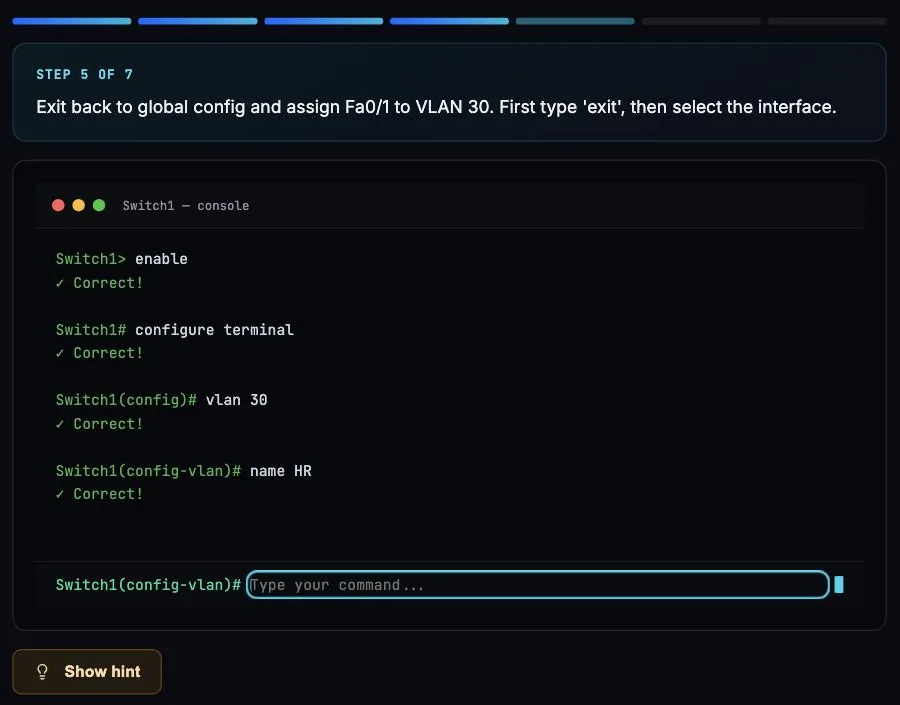
Hands-on analysis labs
Work real security-analysis scenarios — investigate alerts, analyze intrusions, and triage hosts — plus drag-and-drop concept matching. Practice the analyst skills the exam tests, not just recall.
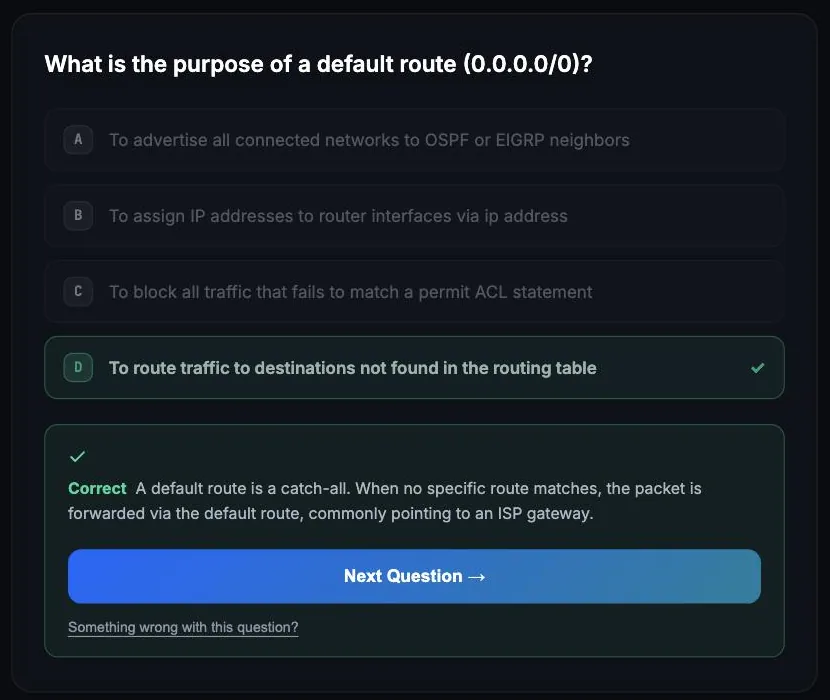
Adaptive practice
The algorithm tracks every question you miss and serves more of those topics, so your weak areas get more reps and every session moves your score.
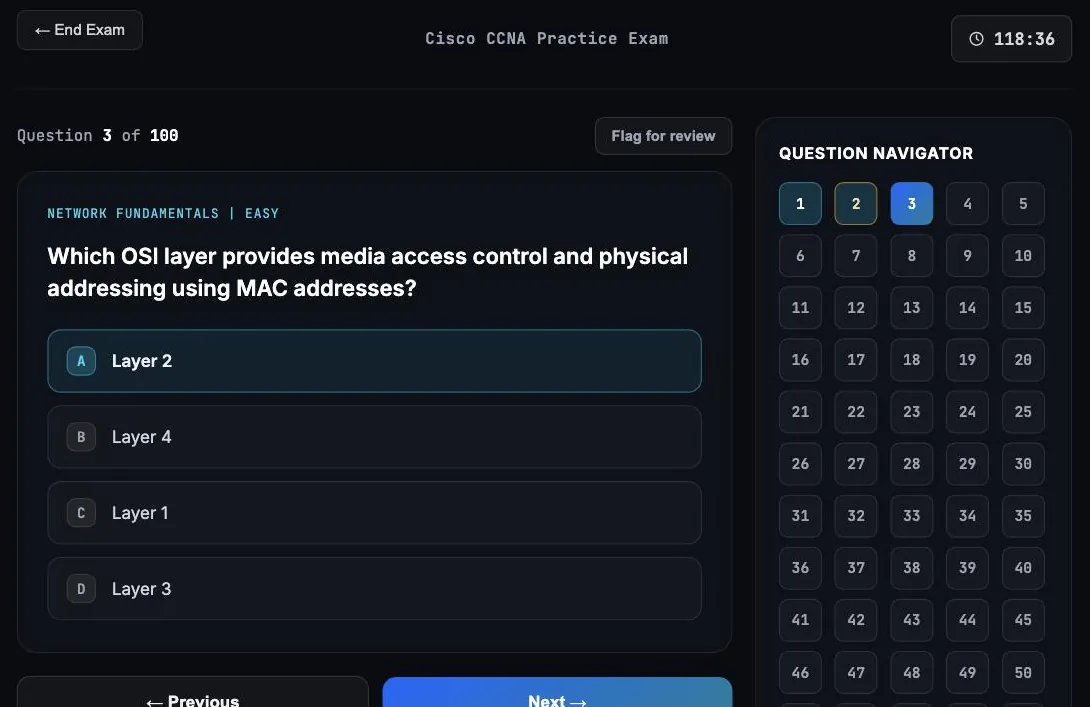
Realistic mock exams
Full-length, timed tests that mirror the real exam — countdown timer, question navigator, mark-for-review, and a 80% pass line so you know you're ready before exam day.
What studying looks like
Real screens from CrushCert's Cisco track (shown: CCNA), not mockups.
What's on the Cisco CyberOps Associate exam
Cisco renamed this exam CCNA Cybersecurity in February 2026 (it was “CyberOps Associate”); the exam code stays 200-201 and it was refreshed to v1.2 with added AI objectives. It runs 120 minutes with roughly 95–105 questions and costs about $300. Cisco doesn't publish an official cut score. The five domains and weightings:
| Domain | Weight |
|---|---|
| Security Concepts | 20% |
| Security Monitoring | 25% |
| Host-Based Analysis | 20% |
| Network Intrusion Analysis | 20% |
| Security Policies & Procedures | 15% |
CrushCert's question bank and labs map to every domain. Hands-on lab and topic coverage includes:
Train on every domain above
Adaptive practice questions and hands-on labs mapped to these exact domains. 7 days free, no card required.
Start free trialFree Cisco CyberOps Associate practice questions: are you ready?
Ten questions across all five exam domains. Answer each one, see the explanation, and find out which topic to work on first. No account needed.
Free readiness check
Least privilege limits each user's access to the minimum required for their role, reducing risk if an account is compromised. Every CrushCert question includes an explanation like this.
A false positive is an alert on benign behavior. The dangerous case is the false negative — malicious activity that produced no alert.
/etc/passwd holds account entries (username, UID, shell); password hashes live in /etc/shadow. Reviewing both helps spot attacker-created accounts.
URL encoding is a standard encoding mechanism for HTTP traffic — but it can also be used to obfuscate attack payloads. The analyst must decode the URL-encoded string and examine the actual payload to accurately classify the alert. Closing as a false positive without decoding could miss a real attack; escalating without decoding lacks due diligence. Blocking without analysis may be premature.
Base metrics describe the vulnerability's intrinsic severity (AV, AC, PR, UI, scope, CIA impact). Temporal adjusts for exploit maturity; environmental for the org's context.
Integrity ensures data is accurate and unaltered. Unauthorized modification is an integrity violation; disclosure breaches confidentiality, and outages affect availability.
Fragmenting traffic can defeat detectors that don't reassemble before matching. Modern IPS engines reassemble streams precisely to counter this.
Windows Security log event 4624 records successful logons with logon type (interactive, network, RDP) and source — fundamental evidence for tracing account misuse.
ARP spoofing sends falsified ARP messages to associate the attacker's MAC address with a legitimate IP (often the default gateway). This causes traffic meant for that IP to be sent to the attacker, enabling man-in-the-middle interception on the local network.
APTs pursue specific objectives (espionage, sabotage) over months, using custom tooling and living-off-the-land techniques to evade detection, versus opportunistic mass attacks.
Why learners pick CrushCert
You practice the way the exam tests you. The exam includes performance-based and scenario items — not just recall. Prep that's only flashcards leaves you guessing on test day. CrushCert's labs put you in the driver's seat.
Pay for one exam or all of them. CyberOps alone is $10/month; the Associate plan is $19/month and covers CCNA, CompTIA A+, Network+, Security+, Azure Fundamentals, and several AWS exams — so if you're stacking certs, it's all included.
You always know your readiness. A live readiness score blends your quiz accuracy, mock results, and lab performance, and points you to exactly what to study next.
A guided plan tells you what to study today. Guided Learning builds a short daily plan from your performance — a warm-up review, a lesson on your weakest topic, flashcards, and a hands-on lab, all in about 20 minutes, with spaced repetition so material comes back right before you'd forget it.
Keep learning: build your Cisco track
Best Cisco CyberOps Associate practice tests in 2026
Boson, CBT Nuggets, Cisco Press, Pluralsight, and CrushCert compared honestly for 200-201 CBROPS.
CAREERIs Cisco CyberOps Associate worth it in 2026?
SOC analyst jobs and pay, how CyberOps stacks against Security+ and CySA+, and who should skip it.
Building your Cisco track? CrushCert also covers CCNA, CCNP Enterprise, CCNP Security, and CCNP Data Center.
Ready to crush the Cisco CyberOps Associate?
Adaptive questions, hands-on labs, and full mock exams — start free for 7 days, no card required.
Start studying freeCisco CyberOps Associate FAQ
What is the Cisco CyberOps Associate exam?
The 200-201 exam (renamed CCNA Cybersecurity in February 2026, formerly CyberOps Associate) runs 120 minutes with roughly 95–105 questions, covering security monitoring, host and network intrusion analysis, and policies.
Does CrushCert include hands-on CyberOps labs?
Yes — analysis-style scenarios where you investigate alerts and triage intrusions, plus drag-and-drop concept matching.
What score do you need to pass CyberOps?
Cisco doesn't publish an official cut score. CrushCert mock exams use an 80% pass line.
How long does it take to study for CyberOps?
Typically 2–4 months. CrushCert's readiness score shows when you're consistently above the pass line.