CCNP Security (SCOR) practice test — with hands-on labs, not just flashcards
Most CCNP Security (SCOR) prep stops at multiple-choice questions. CrushCert adds hands-on labs where you type live Cisco IOS commands into a pre-built topology — no Packet Tracer setup, no simulator to buy — alongside 200 adaptive practice questions and a full timed mock exam. Everything for the exam, in one place.
7 days free · No card required · Built to pass you on the first try
How CrushCert gets you exam-ready
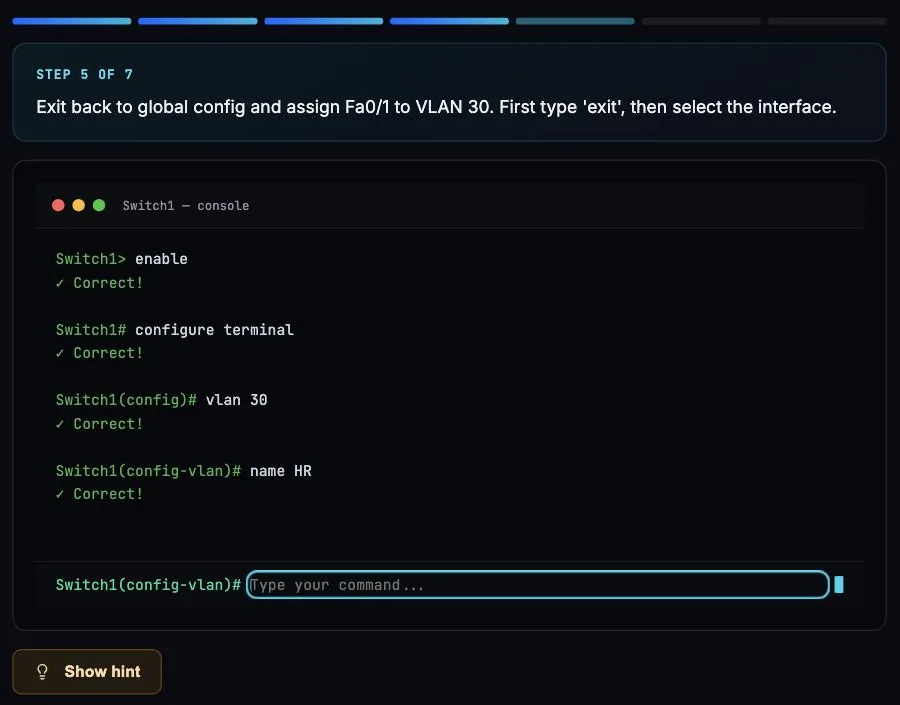
Hands-on Cisco labs
Type real Cisco IOS commands into a simulated terminal, then drag-and-drop and troubleshoot live topologies. This is where the exam is won — and what flashcard apps can't give you.
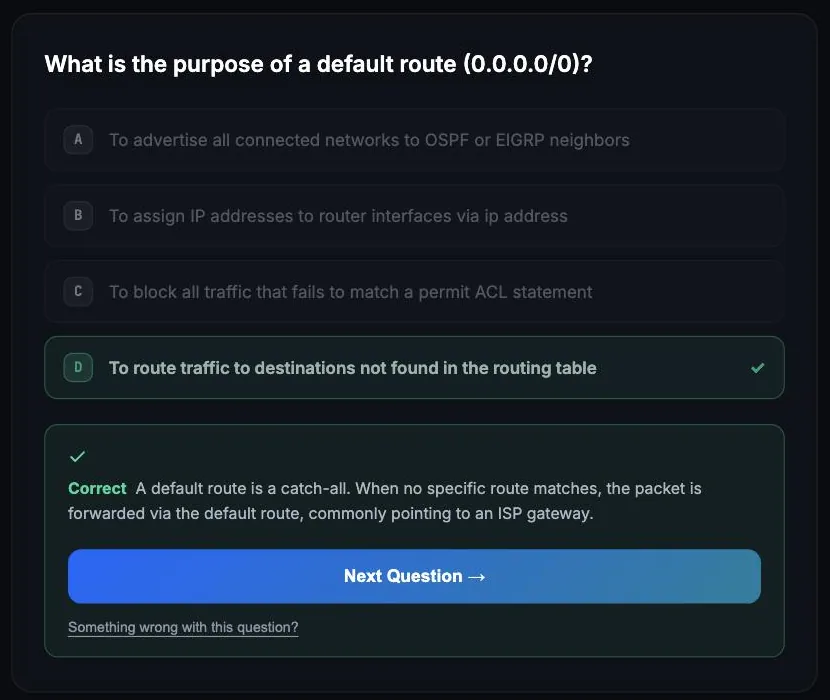
Adaptive practice
The algorithm tracks every question you miss and serves more of those topics, so your weak areas get more reps and every session moves your score.
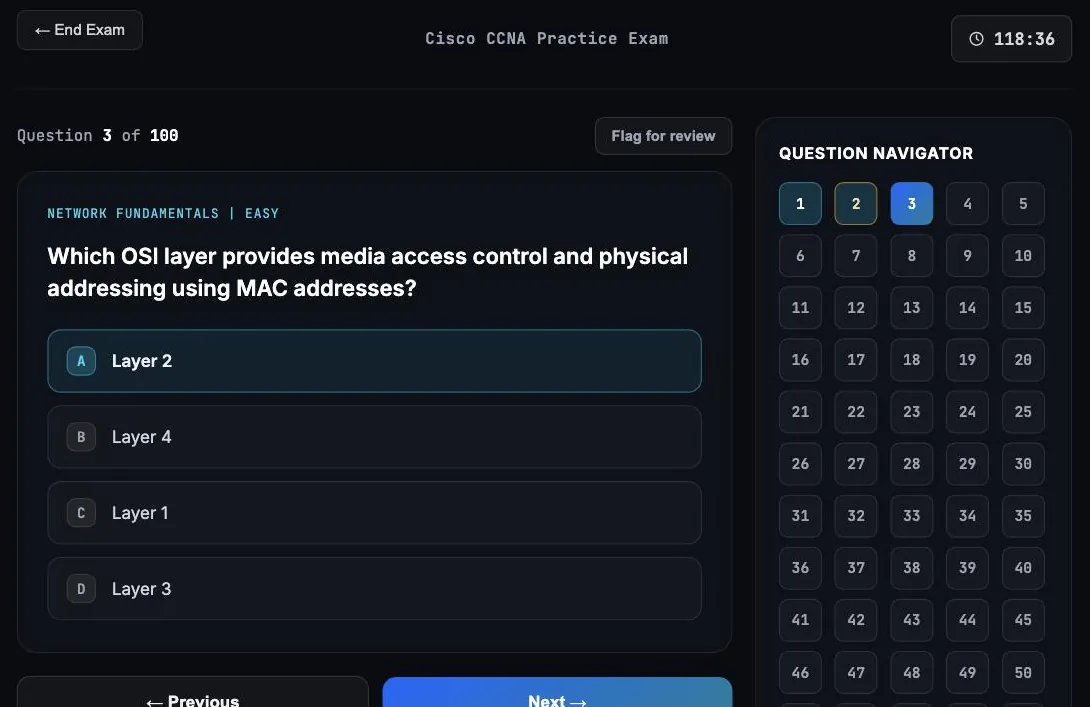
Realistic mock exams
Full-length, timed tests that mirror the real exam — countdown timer, question navigator, mark-for-review, and a 80% pass line so you know you're ready before exam day.
What studying looks like
Real screens from CrushCert's Cisco track (shown: CCNA), not mockups.
What's on the CCNP Security (SCOR) exam
SCOR (350-701) is the CCNP Security core exam: 120 minutes, about $400. Cisco doesn't publish an official cut score. The six v2.0 domains and weightings (effective August 27, 2026):
| Domain | Weight |
|---|---|
| Security Concepts | 20% |
| Network Security | 25% |
| Cloud Security | 15% |
| Secure Service Edge | 10% |
| Endpoint Protection & Detection | 15% |
| Network Access, Visibility & Enforcement | 15% |
CrushCert's question bank and labs map to every domain. Hands-on lab and topic coverage includes:
Train on every domain above
Adaptive practice questions and hands-on labs mapped to these exact domains. 7 days free, no card required.
Start free trialFree CCNP Security (SCOR) practice questions: are you ready?
Ten questions across all six exam domains. Answer each one, see the explanation, and find out which topic to work on first. No account needed.
Free readiness check
Integrity ensures that data has not been modified, tampered with, or corrupted during transmission or storage. Hashing algorithms like SHA-256 are commonly used to verify integrity.
IPsec provides encryption and authentication for site-to-site VPNs, frequently negotiated with IKEv2. Every CrushCert question includes an explanation like this.
In IaaS, the customer is responsible for managing and patching the guest OS, applications, and data. The provider manages only the underlying infrastructure (hypervisor, storage, network).
DNS-layer security acts at the very first step: when the lookup for a malicious domain is blocked, the client never learns the IP address, so no connection is attempted. This makes it the earliest enforcement point for users on or off network.
A posture assessment compares the endpoint against required conditions and marks a failing device noncompliant, placing it in restricted or remediation access. Once the device is remediated and reassessed as compliant, it can be granted full access.
EAP-TLS performs mutual certificate authentication — the strongest common method. PEAP uses a server cert only, building a TLS tunnel for inner password authentication.
FMC exposes a REST API over HTTPS using JSON and an X-auth-access-token obtained from a token request, letting scripts automate policy and object management. SOAP, expect-driven CLI scripting, and SNMP SET are not the FMC automation interface.
DMVPN combines multipoint GRE, NHRP (next-hop resolution), and IPsec so spokes register with the hub and then build direct spoke-to-spoke tunnels on demand.
As you move from IaaS to PaaS to SaaS, the provider assumes progressively more of the stack; with SaaS the customer mainly manages data, user identities, and access configuration. The provider handles the application, OS, and infrastructure.
By default, traffic flowing between interfaces in the same zone is permitted without requiring any explicit policy. Only inter-zone traffic requires zone-pair policies.
Why learners pick CrushCert
You practice the way the exam tests you. The exam includes performance-based and scenario items — not just recall. Prep that's only flashcards leaves you guessing on test day. CrushCert's labs put you in the driver's seat.
Pay for one exam or all of them. CCNP Security alone is $15/month; the Professional plan is $24/month and covers the CCNP core exams, AWS Solutions Architect, SysOps and SA Pro, CySA+, and CASP+/SecurityX — so if you're stacking certs, it's all included.
You always know your readiness. A live readiness score blends your quiz accuracy, mock results, and lab performance, and points you to exactly what to study next.
A guided plan tells you what to study today. Guided Learning builds a short daily plan from your performance — a warm-up review, a lesson on your weakest topic, flashcards, and a hands-on lab, all in about 20 minutes, with spaced repetition so material comes back right before you'd forget it.
Keep learning: build your Cisco track
Best CCNP Security practice tests in 2026
Boson ExSim-Max, CBT Nuggets, Cisco Press, INE, and CrushCert compared honestly for 350-701 SCOR.
STUDY PLANHow long to study for CCNP Security (SCOR)
Realistic timelines by experience level, total hours, and a study plan for the SCOR core exam.
Building your Cisco track? CrushCert also covers CCNA, CCNP Enterprise, CCNP Data Center, and CyberOps.
Ready to crush the CCNP Security (SCOR)?
Adaptive questions, hands-on labs, and full mock exams — start free for 7 days, no card required.
Start studying freeCCNP Security (SCOR) FAQ
What is the CCNP Security SCOR exam?
SCOR (350-701) is the core exam for CCNP Security and also qualifies for the CCIE Security written: 120 minutes, including configuration and troubleshooting items.
Does CrushCert include hands-on SCOR labs?
Yes — type real IOS commands into a simulated terminal and work through VPN, AAA, and secure-access scenarios.
What score do you need to pass SCOR?
Cisco doesn't publish an official cut score. CrushCert mock exams use an 80% pass line to keep practice rigorous.
How long does it take to study for SCOR?
Many candidates spend 3–6 months. CrushCert's weak-area targeting focuses your study.