AWS Solutions Architect Associate practice exam — with hands-on labs, not just flashcards
Most AWS Solutions Architect prep stops at multiple-choice questions. CrushCert adds real hands-on labs where you build and troubleshoot AWS architectures — alongside 150+ adaptive practice questions and a full timed mock exam. Everything for the exam, in one place.
7 days free · No card required · Built to pass you on the first try

How CrushCert gets you exam-ready
Hands-on AWS labs
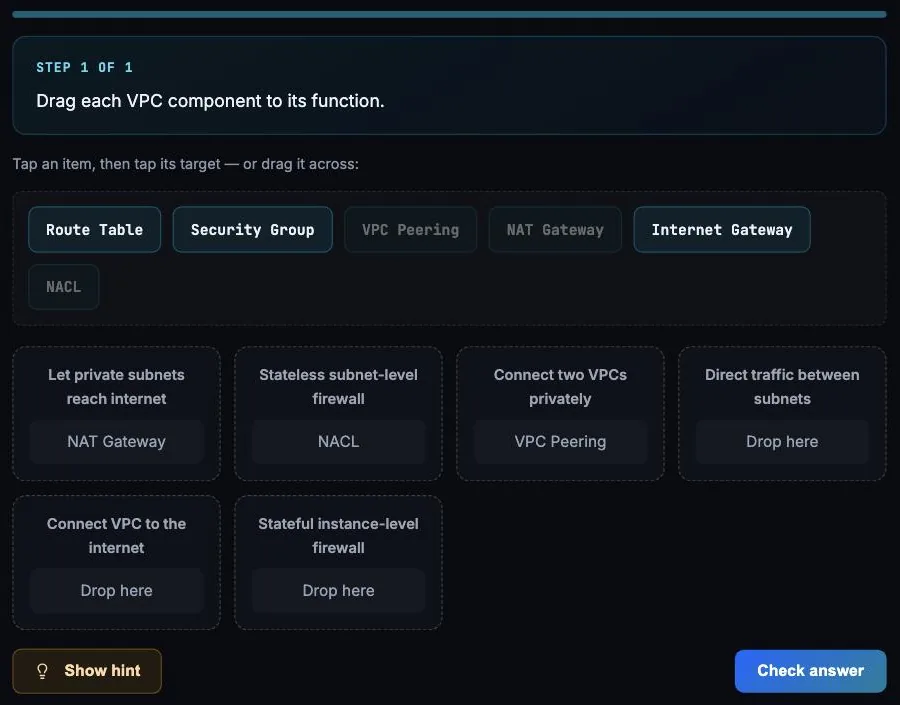
Build and match AWS architectures with drag-and-drop and work through real troubleshooting scenarios — so you learn the services by doing, not just memorizing.
Adaptive practice
The algorithm tracks every question you miss and serves more of those topics, so your weak areas get more reps and every session moves your score.
Realistic mock exams
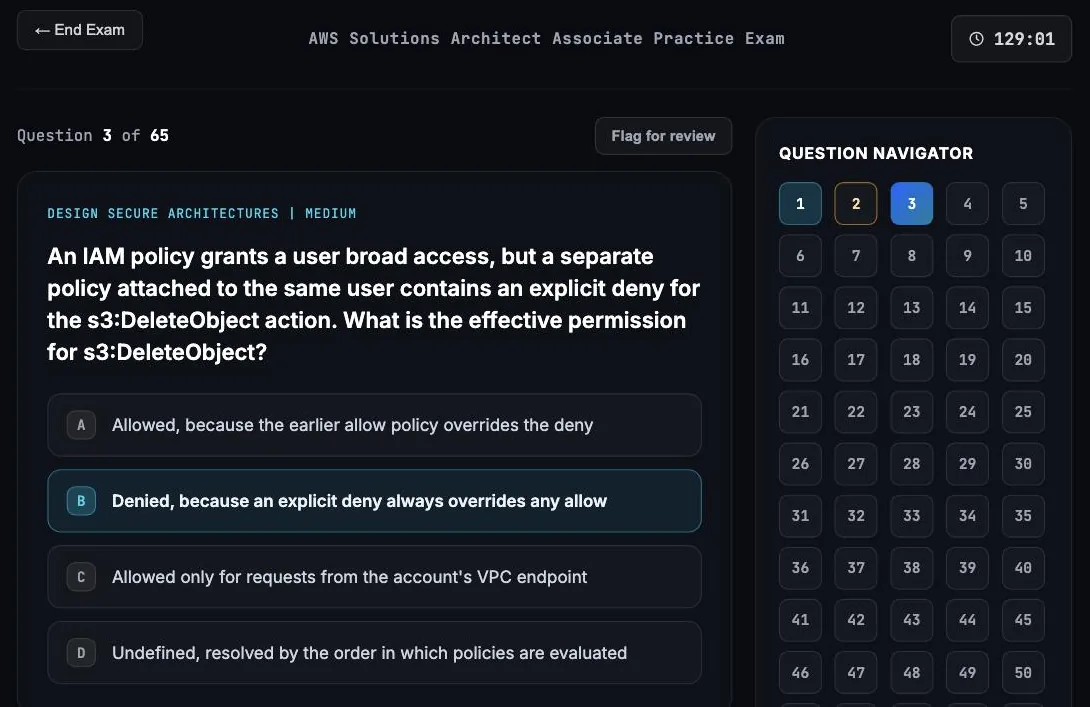
Full-length, timed tests that mirror the real exam — countdown timer, question navigator, mark-for-review, and a 72% pass line so you know you're ready before exam day.
What studying looks like
Real screens from the AWS Solutions Architect Associate track, not mockups.
What's on the AWS Solutions Architect exam
The Solutions Architect Associate (SAA-C03) has 65 questions in 130 minutes, scored on a 100–1,000 scale with a 720 passing score, and costs $150 USD. The four domains and weightings:
| Domain | Weight |
|---|---|
| Design Secure Architectures | 30% |
| Design Resilient Architectures | 26% |
| Design High-Performing Architectures | 24% |
| Design Cost-Optimized Architectures | 20% |
CrushCert's question bank and labs map to every domain. Hands-on lab and topic coverage includes:
Train on every domain above
Adaptive practice questions and hands-on labs mapped to these exact domains. 7 days free, no card required.
Start free trialFree AWS Solutions Architect practice questions: are you ready?
Ten questions across all four exam domains. Answer each one, see the explanation, and find out which topic to work on first. No account needed.
Free readiness check
A NAT Gateway allows instances in private subnets to connect to the internet (for updates, patches) while preventing the internet from initiating connections to those instances.
S3 can host static websites, and CloudFront distributes content globally via edge locations for low latency. This is the most cost-effective and scalable approach for static sites.
Amazon RDS is a managed relational database. DynamoDB is NoSQL, S3 is object storage, and Redshift is a data warehouse. Every CrushCert question includes an explanation like this.
S3 Glacier Deep Archive is the lowest-cost storage class, designed for long-term data archiving with retrieval times of 12 hours. Ideal for compliance and regulatory archives.
A pre-signed URL grants time-limited access to a specific S3 object. The URL creator must have permissions to the object, and the URL expires after a configured time period.
S3 Cross-Region Replication (CRR) automatically replicates objects to a destination bucket in a different AWS Region for compliance, lower-latency access, or disaster recovery.
Latency-based routing answers DNS queries with the Region that gives the user the lowest measured latency. Geolocation routes by the user's location regardless of latency.
S3 Intelligent-Tiering automatically moves objects between access tiers based on usage, optimizing cost with no retrieval fees and no performance impact, which suits unknown or changing access patterns. Standard is more costly for infrequently accessed data, and Glacier/One Zone-IA add retrieval or availability tradeoffs.
Object Lock with compliance mode enforces WORM (write once, read many) retention that even the root user cannot shorten or remove — designed for regulations like SEC 17a-4.
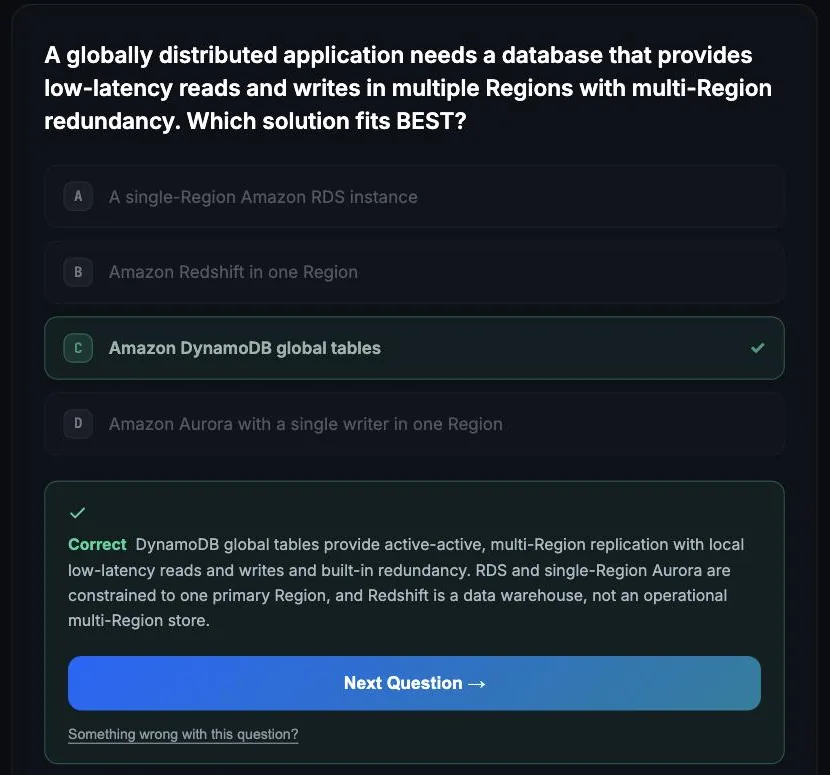
DynamoDB global tables provide active-active, multi-Region replication with local low-latency reads and writes and built-in redundancy. RDS and single-Region Aurora are constrained to one primary Region, and Redshift is a data warehouse, not an operational multi-Region store.
Why learners pick CrushCert
You practice the way the exam tests you. The exam includes performance-based and scenario items — not just recall. Prep that's only flashcards leaves you guessing on test day. CrushCert's labs put you in the driver's seat.
Pay for one exam or all of them. AWS Solutions Architect alone is $15/month; the Professional plan is $24/month and covers the CCNP core exams, AWS Solutions Architect and SA Pro, CySA+, and CASP+/SecurityX — so if you're stacking certs, it's all included.
You always know your readiness. A live readiness score blends your quiz accuracy, mock results, and lab performance, and points you to exactly what to study next.
A guided plan tells you what to study today. Guided Learning builds a short daily plan from your performance — a warm-up review, a lesson on your weakest topic, flashcards, and a hands-on lab, all in about 20 minutes, with spaced repetition so material comes back right before you'd forget it.
Keep learning: AWS guides & path
Best AWS Solutions Architect Associate practice tests in 2026
Tutorials Dojo, Stephane Maarek, Whizlabs, CrushCert and more — the top SAA-C03 practice exams compared.
STUDY PLANAWS Solutions Architect study plan: 6-week & 4-week schedules
A day-by-day SAA-C03 plan by domain — pick a track, follow the daily checklist, and walk in ready.
Going further with AWS? CrushCert also covers Cloud Practitioner, Developer Associate, AI Practitioner, and SA Professional — one plan, every exam. Coming from Tutorials Dojo? See the CrushCert vs Tutorials Dojo comparison.
Ready to crush the AWS Solutions Architect?
Adaptive questions, hands-on labs, and full mock exams — start free for 7 days, no card required.
Start studying freeAWS Solutions Architect FAQ
How many questions are on the SAA-C03 exam?
The Solutions Architect Associate has 65 questions in 130 minutes, scenario-heavy and focused on architectural trade-offs.
Does CrushCert include hands-on AWS labs?
Yes — drag-and-drop architecture labs where you design and match services for security, resilience, performance, and cost.
What score do you need to pass?
720 on a 100–1,000 scale. CrushCert mock exams use a 72% pass line to match the real bar.
How long does it take to study?
Typically 1–3 months. CrushCert's weak-area targeting focuses your time on the domains you miss most.