CISSP practice test — think like the risk owner
The CISSP rewards managerial judgment, not recall. CrushCert gives you 250 original scenario-style questions written against the ISC2 outline and tagged to the sub-objective they test (1.1 through 8.5), with an explanation on every question that says why each wrong answer is wrong. Add six hands-on drag-and-drop labs, flashcards with spaced repetition, and a 125-question timed mock exam, and you have a practice bank for both the 2024 and the 2027 outline.
7 days free · No card required · Built to pass you on the first try
Exam update: the 2027 CISSP outline takes effect April 15, 2027; the 2024 outline governs exams taken through April 14, 2027. CrushCert covers both: pick the 2024 or 2027 outline on your dashboard and every quiz, flashcard and mock exam follows the version you are sitting. See what changes and which outline to study →
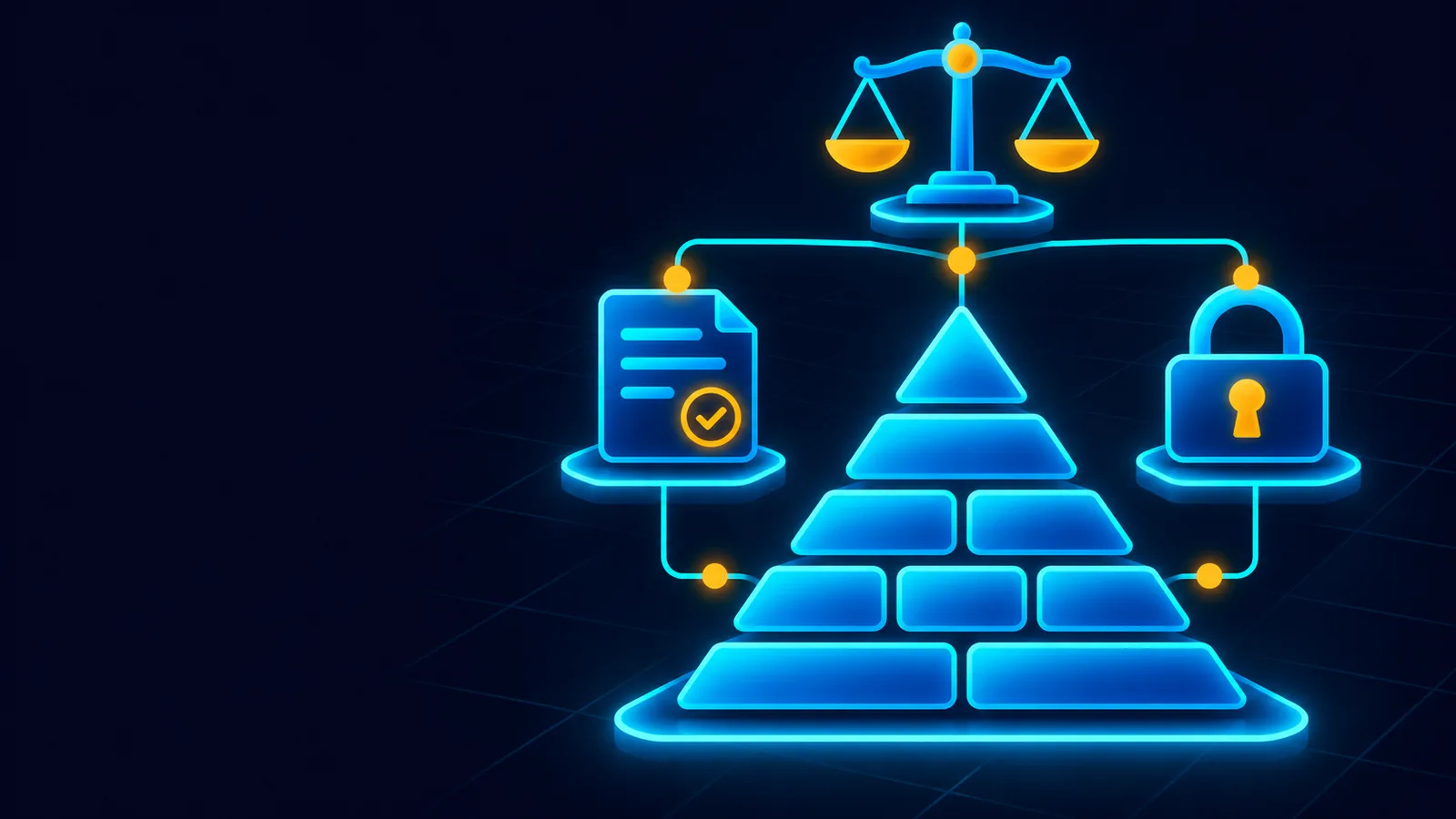
How CrushCert gets you exam-ready
Written to both ISC2 outlines
Every question is tagged by outline: 232 apply to both the 2024 and the 2027 exam, 18 cover 2027-only topics such as passwordless authentication, post-quantum cryptography and AI threats. Switch the version on your dashboard and the bank follows.
Adaptive practice
The algorithm tracks every question you miss and serves more of those topics, so your weak domains get more reps and every session moves your score.
Realistic mock exams
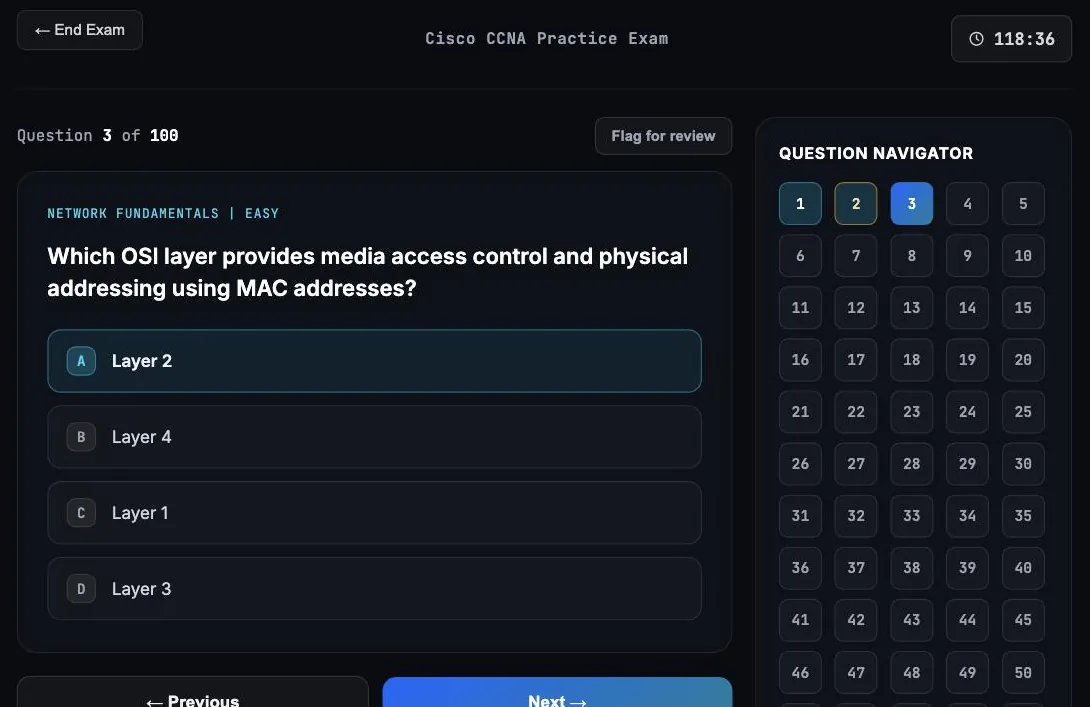
Full-length, timed tests — 125 questions, a 180-minute countdown, question navigator, mark-for-review, and a 70% pass line that mirrors the real 700-out-of-1000 bar. Not a CAT simulator, but the same clock and the same judgment calls.
Six hands-on labs
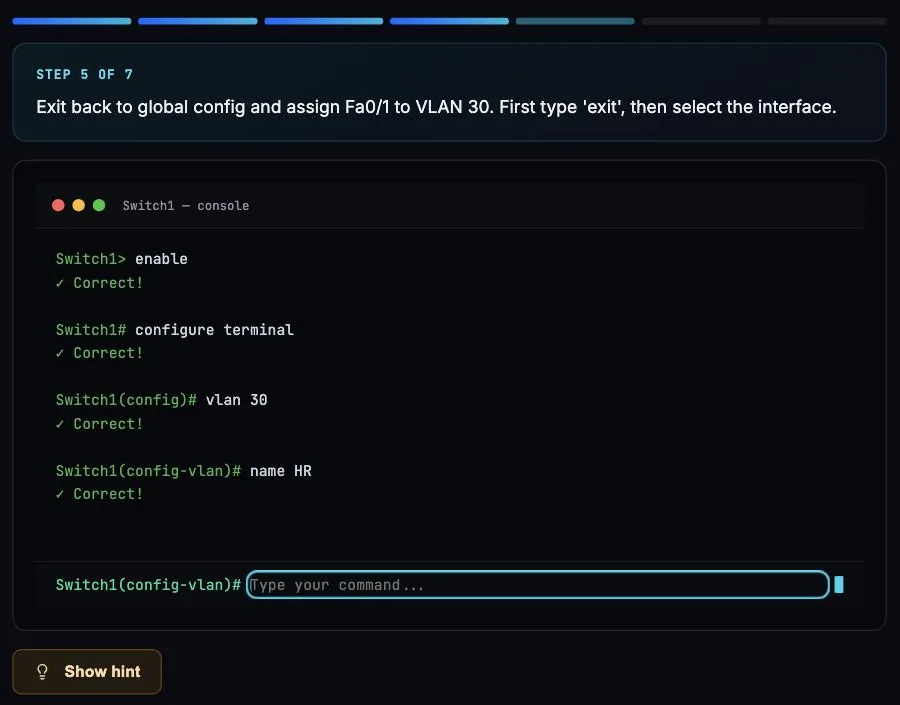
Drag-and-drop labs built for the exam's advanced item types: Match the Risk Response, Match the Security Model (Bell-LaPadula, Biba, Clark-Wilson, Brewer-Nash), Match the Access Control Model (DAC, MAC, RBAC, RuBAC, ABAC, RAdAC), Order the DR Tests, Order the ISC2 Incident Management Steps, and Match the Software Security Test (SAST, DAST, SCA, fuzzing).
What studying looks like
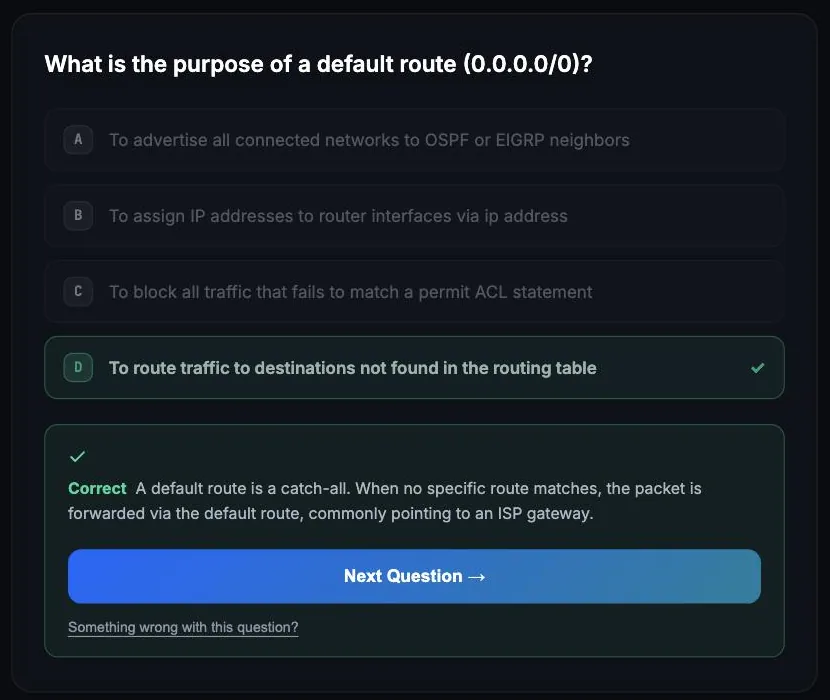
Real screens from CrushCert (shown: the CCNA track), not mockups.
What's on the CISSP exam
The English CISSP is a Computerized Adaptive Test (CAT): 100 to 150 items in 3 hours, multiple choice plus advanced item types such as drag-and-drop and hotspot, scored 700 out of 1000 to pass. It costs $749 USD at Pearson VUE, and a retake costs the full fee again (30 days before a second attempt, 90 before a third, 180 after that). To hold the credential you need five years of cumulative paid experience in two or more domains; one year can be waived with a relevant degree or an approved credential, and if you pass without the experience you become an Associate of ISC2 with six years to earn it. After certification, the annual maintenance fee is $135 and you owe 120 CPE credits per three-year cycle. The eight domains and their weights on each outline:
| Domain | 2024 outline | 2027 outline |
|---|---|---|
| Security and Risk Management (2027: Security Governance and Risk Management) | 16% | 13.6% |
| Asset Security | 10% | 12% |
| Security Architecture and Engineering | 13% | 12.8% |
| Communication and Network Security | 13% | 12.8% |
| Identity and Access Management (IAM) | 13% | 13.6% |
| Security Assessment and Testing | 12% | 11.2% |
| Security Operations | 13% | 12.8% |
| Software Development Security | 10% | 11.2% |
The 2024 outline governs exams through April 14, 2027; the 2027 outline applies from April 15, 2027. CrushCert's bank maps to every domain (34 / 30 / 32 / 32 / 34 / 28 / 32 / 28 questions, in outline order). Topic coverage includes:
Train on every domain above
Adaptive practice questions and hands-on labs mapped to these exact domains. 7 days free, no card required.
Start free trialFree CISSP practice questions: are you ready?
Ten questions across all eight exam domains. Answer each one, see the explanation, and find out which topic to work on first. No account needed.
Free readiness check
The ISC2 Code of Professional Ethics lists four canons in priority order, and the first canon, protecting society, the common good, necessary public trust and confidence, and the infrastructure, governs when canons conflict. Acting honorably is the second canon and does not override public safety. Service to principals (the client) is the third canon and is explicitly subordinate to the first two. Advancing the profession is the fourth and lowest-priority canon. Every CrushCert question includes an explanation like this.
Aggregation (and inference) can make a collection more sensitive than its parts, so the compiled dataset must be classified at the level of what it reveals. A dataset does not simply inherit its component classification when the combination creates new sensitive information. Individual shipments being observable does not make the full customer profile public.
With Online Certificate Status Protocol (OCSP) stapling the server periodically obtains a time-stamped, CA-signed status and includes it in the TLS handshake, so clients get fresh revocation data with no extra round trip. Direct OCSP queries add latency and leak browsing activity to the CA. Certificate revocation lists (CRLs) can be large and are poorly suited to per-connection download. Skipping revocation checks leaves clients trusting a compromised certificate.
A low signal-to-noise ratio with adequate signal means the noise floor is high, so the fix is to find the interfering source (motors, microwave units, rogue radios) or move to a cleaner channel. Raising transmit power can worsen co-channel interference elsewhere and does not reduce the noise. A faster access point still contends with the same noise. An additional service set identifier changes nothing about the radio environment.
Access to assets cannot be provisioned, controlled, or reviewed correctly until the organization knows what assets exist and how sensitive they are, so inventory and classification come first. DLP agents and MFA are useful controls, but applied before classification they protect everything equally and may miss what matters most. Copying the parent company's ACLs assumes the new unit's data, roles, and owners are the same, which has not been established.
Backup verification means proving data can be restored, so the meaningful evidence is the outcome of periodic test restores, including whether files were intact and how long recovery took. Job completion logs only show that a copy operation ran, not that the copy is usable. Capacity reports show room exists, not that backups are recoverable. A vendor's durability commitment is a contractual promise rather than measured evidence of the organization's own recovery capability.
The order of volatility directs responders to capture the most short-lived data first: registers and cache, then RAM and network state, then running processes, then disk, and finally backups and archives. Memory contents and process state vanish the moment the system loses power, so they are collected first. A disk image and logs on disk are far less volatile, and backup tapes are the least volatile source of all.
Branch protection with mandatory review and signed commits ensures that no single person can introduce code to the production branch unnoticed and that commit authorship is verifiable. A local linter catches style issues and is easily skipped. More frequent builds would deploy malicious changes faster, not prevent them. Encryption at rest protects confidentiality of the code but does nothing to control what gets merged.
Due diligence before closing lets the acquirer understand the target's risks, liabilities, and control gaps, and factor them into the price and integration plan. Migrating users and applying policies are integration tasks that depend on first knowing the target's posture. Connecting networks before assessment can expose the acquirer to the target's existing compromises and is a common post-acquisition failure.
FIDO2 and WebAuthn credentials sign a challenge that includes the origin of the site the browser is actually on, so a proxy phishing site receives a signature it cannot replay against the real site. TOTP and SMS codes are simply typed by the user and relayed by the adversary-in-the-middle in real time. Number-matching push notifications reduce accidental approvals, but the user still approves a session the attacker initiated through the proxy.
Why learners pick CrushCert
You practice the way the exam tests you. The CISSP is scenario-heavy — "which action should the security manager take FIRST?" — and the right answer is usually the one a risk owner would pick, not the most technical one. Every CrushCert question is written in that style, every explanation tells you why the other three choices are wrong, and the six labs drill the matching and ordering tasks the advanced item types are built on. It is a good step up for Security+ and CySA+ holders who already know the technical material and need to practice the managerial judgment.
It is a practice bank, not a course. CrushCert will not teach you the eight domains from scratch and it does not simulate CAT. Read a study guide first, then use the questions, labs and mock exam to find the domains you still miss and to rehearse the exam's way of thinking.
Pay for one exam or all of them. CISSP alone is $15/month; the Professional plan is $24/month and covers every exam on CrushCert — Security+, CySA+, CASP+, the CCNPs, AWS Solutions Architect and more — so if you're stacking certs, it's all included.
You always know your readiness. A live readiness score blends your quiz accuracy, mock results, and lab performance, and points you to exactly what to study next.
A guided plan tells you what to study today. Guided Learning builds a short daily plan from your performance — a warm-up review, a lesson on your weakest topic, and flashcards, all in about 20 minutes, with spaced repetition so material comes back right before you'd forget it.
Keep learning: CISSP reading
Best CISSP practice tests in 2026
Boson, the ISC2 Official Practice Tests, the ISC2 app, Pocket Prep, Quantum Exams, DestCert and CrushCert — price, question count, and how each compares with the real exam.
WORTH IT?Is the CISSP worth it in 2026?
Still the most-requested security cert in US job postings. Who the $749 exam and $135 annual fee pay off for, and who should wait.
TIMELINEHow long to study for the CISSP?
3–6 months at 8–10 hours a week for most practitioners, 1–2 months for CISM holders, longer if governance and legal topics are new.
STUDY PLANCISSP study plan
A week-by-week schedule across the eight domains, which study guide to pair with practice questions, and when to sit your first mock.
STEPPING STONECompTIA Security+ practice test
Not ready for the CISSP experience requirement yet? Security+ is on the ISC2 waiver list and covers the technical ground the CISSP assumes.
Not sure which cert comes next? Take the two-minute Which certification should I take? quiz.
Ready to crush the CISSP?
Scenario questions, six hands-on labs, explanations on every answer, and a full mock exam — start free for 7 days, no card required.
Start studying freeCISSP FAQ
Is the CISSP hard?
Yes, mostly because of its breadth and its angle. The exam covers eight domains, runs 100 to 150 adaptive items in 3 hours, and needs 700 out of 1000 to pass. The harder part for most technical people is that it expects you to answer as a risk owner or security manager, picking the best of several plausible options, rather than reciting a technical fact. It is not an entry-level certification: ISC2 requires five years of experience to hold the credential.
How long does it take to study for the CISSP?
Most experienced practitioners spend 3 to 6 months at 8 to 10 hours a week, roughly 120 to 200 hours in total. Very experienced people and CISM holders often need 1 to 2 months. If governance, legal and business-continuity topics are new to you, plan for longer.
Should I study the 2024 or the 2027 CISSP outline?
Study the outline that will be in force on your exam date. The 2024 outline governs exams taken through April 14, 2027; the 2027 outline takes effect April 15, 2027. Both have the same eight domains, re-weighted, with Domain 1 renamed Security Governance and Risk Management and new topics added such as passwordless authentication, post-quantum cryptography, AI threats and ethics, and CNAPP. Nothing big is removed. CrushCert tags every question by outline: 232 apply to both and 18 are 2027-only, and you pick the version on your dashboard.
What is the CISSP experience requirement?
Five years of cumulative, paid work in two or more of the eight domains. One year can be waived with a relevant degree or an approved credential such as Security+, CySA+, SecurityX (CASP+), CISM, CCSP, SSCP, CCNA, CCNP Security or AWS Security Specialty. As of April 1, 2026, CEH, CISA, CRISC, OSCP, GSEC and GCIH no longer count toward the waiver. If you pass without the experience you become an Associate of ISC2 and have six years to earn it.
How does the CISSP CAT format work?
The English exam uses Computerized Adaptive Testing: the questions you get depend on how you have answered so far, you see between 100 and 150 items, and you have 3 hours. The passing score is 700 out of 1000. Items are multiple choice plus advanced item types such as drag-and-drop and hotspot. CrushCert's mock exam is a fixed 125-question, 180-minute test with a 70% pass line that mirrors 700 out of 1000; it is not a CAT simulator.
Is CrushCert enough on its own to pass the CISSP?
No. CrushCert is a question bank, six labs and a mock exam, not a full course. Pair it with a study guide such as the ISC2 CISSP Official Study Guide or the CISSP All-in-One, read the guide first, then use CrushCert to practice the risk-owner judgment the exam rewards and to find the domains you still miss.